1
/
of
1
ELK Biotechnology
SKU:ES1799
BTR1 Rabbit Polyclonal Antibody
Regular price
$248.00 USD
Regular price
Sale price
$248.00 USD
Unit price
/
per
Shipping calculated at checkout.
Couldn't load pickup availability
BTR1 Rabbit Polyclonal Antibody
Overview
| Product name: | BTR1 rabbit pAb |
| Alternative Names: | SLC4A11; BTR1; Sodium bicarbonate transporter-like protein 11; Bicarbonate transporter-related protein 1; Sodium borate cotransporter 1; NaBC1; Solute carrier family 4 member 11 |
| Applications: | WB;ELISA |
| Recommended Dilutions: | Western Blot: 1/500 - 1/2000. ELISA: 1/20000. Not yet tested in other applications. |
| Immunogen: | The antiserum was produced against synthesized peptide derived from human SLC4A11. AA range:291-340 |
| Storage: | Rabbit |
| Storage: | -20°C/1 year |
| Clonality: | Polyclonal |
| Isotype: | IgG |
| Concentration: | 1 mg/ml |
| Observed Band: | 100kD |
| GeneID(Human): | 83959 |
| Human Swiss-Prot No: | Q8NBS3 |
| Cellular localization: | Cell membrane ; Multi-pass membrane protein . Basolateral cell membrane ; Multi-pass membrane protein . |
| Background: | This gene encodes a voltage-regulated, electrogenic sodium-coupled borate cotransporter that is essential for borate homeostasis, cell growth and cell proliferation. Mutations in this gene have been associated with a number of endothelial corneal dystrophies including recessive corneal endothelial dystrophy 2, corneal dystrophy and perceptive deafness, and Fuchs endothelial corneal dystrophy. Multiple transcript variants encoding different isoforms have been described. [provided by RefSeq, Mar 2010], |
| Species Reactivity: | Human;Rat;Mouse; |
-
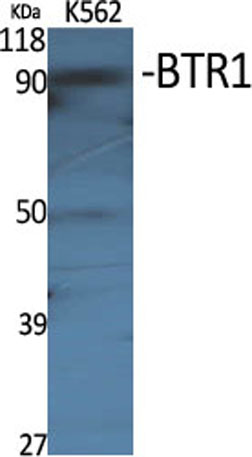
Western Blot analysis of various cells using BTR1 Polyclonal Antibody -
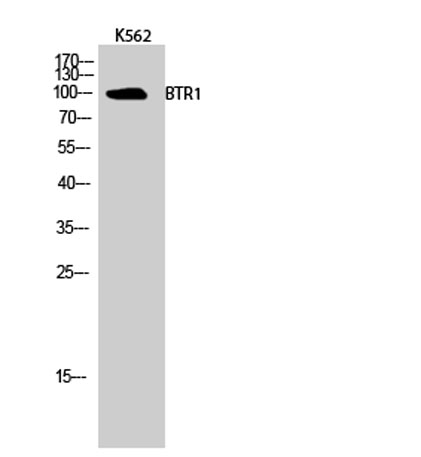
Western Blot analysis of K562 cells using BTR1 Polyclonal Antibody -
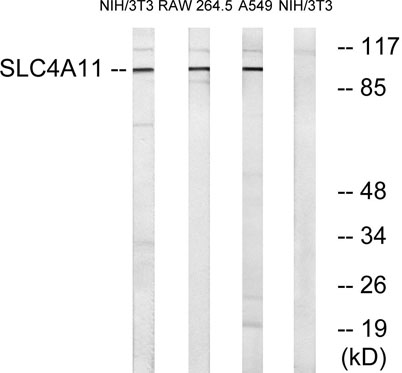
Western blot analysis of lysates from NIH/3T3, RAW264.7, and A549 cells, using SLC4A11 Antibody. The lane on the right is blocked with the synthesized peptide. -
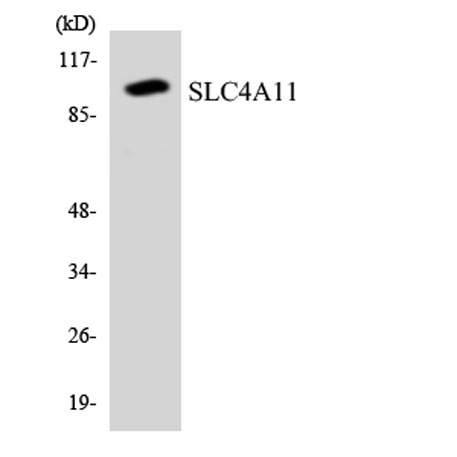
Western blot analysis of the lysates from HT-29 cells using SLC4A11 antibody.

Share