IF: 1:50-200 Western Blot: 1/500 - 1/2000. Immunohistochemistry: 1/100 - 1/300. ELISA: 1/40000. Not yet tested in other applications.
Immunogen:
The antiserum was produced against synthesized peptide derived from human YAP around the phosphorylation site of Ser127. AA range:93-142
Storage:
-20°C/1 year
Storage:
Rabbit
Clonality:
Polyclonal
Isotype:
IgG
Concentration:
1 mg/ml
Observed Band:
65kD
GeneID(Human):
10413
Human Swiss-Prot No:
P46937
Cellular localization:
Cytoplasm . Nucleus . Both phosphorylation and cell density can regulate its subcellular localization (PubMed:18158288, PubMed:20048001). Phosphorylation sequesters it in the cytoplasm by inhibiting its translocation into the nucleus (PubMed:18158288, PubMed:20048001). At low density, predominantly nuclear and is translocated to the cytoplasm at high density (PubMed:18158288, PubMed:20048001, PubMed:25849865). PTPN14 induces translocation from the nucleus to the cytoplasm (PubMed:22525271). Localized mainly to the nucleus in the early stages of embryo development with expression becoming evident in the cytoplasm at the blastocyst and epiblast stages (By similarity). .
Background:
This gene encodes a downstream nuclear effector of the Hippo signaling pathway which is involved in development, growth, repair, and homeostasis. This gene is known to play a role in the development and progression of multiple cancers as a transcriptional regulator of this signaling pathway and may function as a potential target for cancer treatment. Alternative splicing results in multiple transcript variants encoding different isoforms. [provided by RefSeq, Aug 2013],


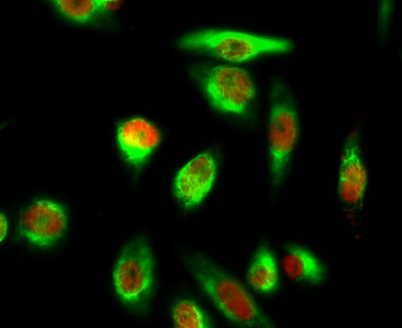 Immunofluorescence analysis of Hela cell. 1,YAP (phospho Ser127) Polyclonal Antibody(red) was diluted at 1:200(4° overnight). β-Tubulin Monoclonal Antibody(5G3)(green) was diluted at 1:200(4° overnight). 2, Goat Anti Rabbit Alexa Fluor 594 Catalog:RS3611
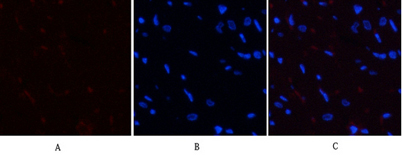 Immunofluorescence analysis of rat-heart tissue. 1,YAP (phospho Ser127) Polyclonal Antibody(red) was diluted at 1:200(4°C,overnight). 2, Cy3 labled Secondary antibody was diluted at 1:300(room temperature, 50min).3, Picture B: DAPI(blue) 10min. Picture A:
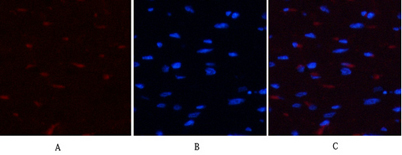 Immunofluorescence analysis of rat-heart tissue. 1,YAP (phospho Ser127) Polyclonal Antibody(red) was diluted at 1:200(4°C,overnight). 2, Cy3 labled Secondary antibody was diluted at 1:300(room temperature, 50min).3, Picture B: DAPI(blue) 10min. Picture A:
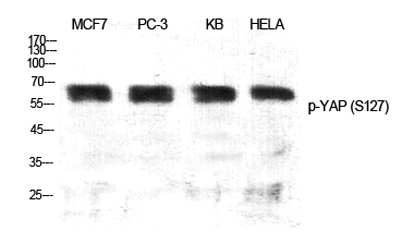 Western Blot analysis of various cells using Phospho-YAP (S127) Polyclonal Antibody diluted at 1:500 cells nucleus extracted by Minute TM Cytoplasmic and Nuclear Fractionation kit (SC-003,Inventbiotech,MN,USA).