

| TARGET | |
|---|---|
| SYNONYMS |
AXL;UFO |
| HOST SPECIES |
Rabbit |
| DESCRIPTION |
Anti-AXL antibody(DM158); Rabbit mAb |
| DELIVERY |
In Stock |
| UNIPROT ID |
P30530 |
| IGG TYPE |
Rabbit IgG |
| CLONALITY |
Monoclonal |
| REACTIVITY |
Human |
| APPLICATIONS |
ELISA; Flow Cyt |
| RECOMMENDED DILUTIONS |
ELISA 1:5000-10000; Flow Cyt 1:100 |
| PURIFICATION |
Purified from cell culture supernatant by affinity chromatography |
| FORMULATION & RECONSTITUTION |
Lyophilized from sterile PBS, pH 7.4. Normally 5 % – 8% trehalose is added as protectants before lyophilization. Please see Certificate of Analysis for specific instructions of reconstitution. |
| STORAGE & SHIPPING |
Store at -20°C to -80°C for 12 months in lyophilized form. After reconstitution, if not intended for use within a month, aliquot and store at -80°C (Avoid repeated freezing and thawing). Lyophilized proteins are shipped at ambient temperature. |
| BACKGROUND |
The protein encoded by this gene is a member of the Tyro3-Axl-Mer (TAM) receptor tyrosine kinase subfamily. The encoded protein possesses an extracellular domain which is composed of two immunoglobulin-like motifs at the N-terminal; followed by two fibronectin type-III motifs. It transduces signals from the extracellular matrix into the cytoplasm by binding to the vitamin K-dependent protein growth arrest-specific 6 (Gas6). This gene may be involved in several cellular functions including growth; migration; aggregation and anti-inflammation in multiple cell types. Alternative splicing results in multiple transcript variants of this gene. |
| USAGE |
Research use only |
Dima Biotech
SKU:DME100158
Anti-AXL antibody(DM158), Rabbit mAb
Anti-AXL antibody(DM158), Rabbit mAb
Regular price
$438.00 USD
Regular price
Sale price
$438.00 USD
Unit price
per
Shipping calculated at checkout.
Couldn't load pickup availability
PRODUCT DATA
IMAGES
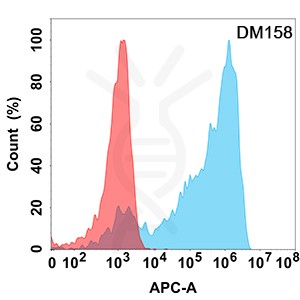
Figure 1. Flow cytometry analysis with Anti-AXL (DM158) on Expi293 cells transfected with human AXL (Blue histogram) or Expi293 transfected with irrelevant protein (Red histogram).
