PRODUCT DATA
| TARGET | |
|---|---|
| SYNONYMS |
BN-1; C-C CKR-6; CC-CKR-6; CCR-6; CD196; CKR-L3; CKRL3; CMKBR6; DCR2; DRY6; GPR29; GPRCY4; STRL22 |
| HOST SPECIES |
Rabbit |
| DESCRIPTION |
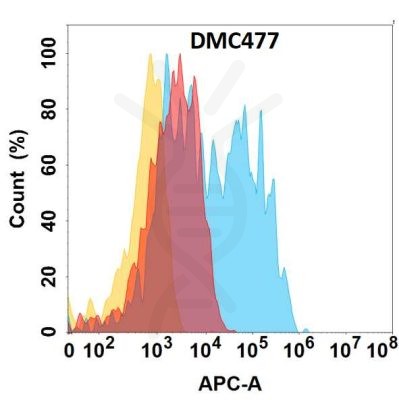
Anti-CCR6 antibody(DMC477); IgG1 Chimeric mAb |
| DELIVERY |
In Stock |
| UNIPROT ID |
P51684 |
| IGG TYPE |
Rabbit:Human Fc chimeric IgG1 |
| CLONALITY |
Monoclonal |
| REACTIVITY |
Human |
| APPLICATIONS |
Flow Cyt |
| RECOMMENDED DILUTIONS |
Flow Cyt 1:100 |
| PURIFICATION |
Purified from cell culture supernatant by affinity chromatography |
| FORMULATION & RECONSTITUTION |
Lyophilized from sterile PBS, pH 7.4. Normally 5 % – 8% trehalose is added as protectants before lyophilization. Please see Certificate of Analysis for specific instructions of reconstitution. |
| STORAGE & SHIPPING |
Store at -20°C to -80°C for 12 months in lyophilized form. After reconstitution, if not intended for use within a month, aliquot and store at -80°C (Avoid repeated freezing and thawing). Lyophilized proteins are shipped at ambient temperature. |
| BACKGROUND |
This gene encodes a member of the beta chemokine receptor family; which is predicted to be a seven transmembrane protein similar to G protein-coupled receptors. The gene is preferentially expressed by immature dendritic cells and memory T cells. The ligand of this receptor is macrophage inflammatory protein 3 alpha (MIP-3 alpha). This receptor has been shown to be important for B-lineage maturation and antigen-driven B-cell differentiation; and it may regulate the migration and recruitment of dentritic and T cells during inflammatory and immunological responses. Alternatively spliced transcript variants that encode the same protein have been described for this gene. [provided by RefSeq; Jul 2008] |
| USAGE |
Research use only |