PRODUCT DATA
| TARGET | |
|---|---|
| SYNONYMS |
LMOR; M-OR-1; MOP; MOR; MOR1; OPRM |
| HOST SPECIES |
Rabbit |
| DESCRIPTION |
Anti-CD164 antibody(DMC476); IgG1 Chimeric mAb |
| DELIVERY |
In Stock |
| UNIPROT ID |
Q04900 |
| IGG TYPE |
Rabbit:Human Fc chimeric IgG1 |
| CLONALITY |
Monoclonal |
| REACTIVITY |
Human |
| APPLICATIONS |
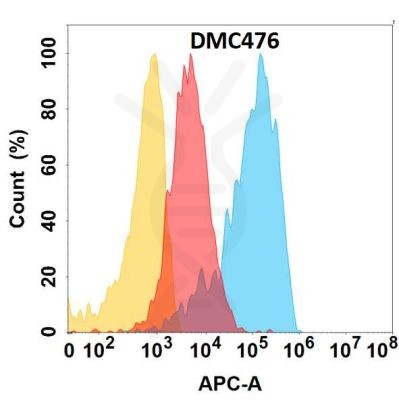
Flow Cyt |
| RECOMMENDED DILUTIONS |
Flow Cyt 1:100 |
| PURIFICATION |
Purified from cell culture supernatant by affinity chromatography |
| FORMULATION & RECONSTITUTION |
Lyophilized from sterile PBS, pH 7.4. Normally 5 % – 8% trehalose is added as protectants before lyophilization. Please see Certificate of Analysis for specific instructions of reconstitution. |
| STORAGE & SHIPPING |
Store at -20°C to -80°C for 12 months in lyophilized form. After reconstitution, if not intended for use within a month, aliquot and store at -80°C (Avoid repeated freezing and thawing). Lyophilized proteins are shipped at ambient temperature. |
| BACKGROUND |
This gene encodes one of at least three opioid receptors in humans; the mu opioid receptor (MOR). The MOR is the principal target of endogenous opioid peptides and opioid analgesic agents such as beta-endorphin and enkephalins. The MOR also has an important role in dependence to other drugs of abuse; such as nicotine; cocaine; and alcohol via its modulation of the dopamine system. The NM_001008503.2:c.118A>G allele has been associated with opioid and alcohol addiction and variations in pain sensitivity but evidence for it having a causal role is conflicting. Multiple transcript variants encoding different isoforms have been found for this gene. Though the canonical MOR belongs to the superfamily of 7-transmembrane-spanning G-protein-coupled receptors some isoforms of this gene have only 6 transmembrane domains. [provided by RefSeq; Oct 2013] |
| USAGE |
Research use only |