Elabscience
SKU:E-AB-67804
PSMD5 Polyclonal Antibody
PSMD5 Polyclonal Antibody
Couldn't load pickup availability
PSMD5 Polyclonal Antibody
The PSMD5 Polyclonal Antibody is a highly reliable and efficient tool designed for the detection and analysis of PSMD5 protein expression in various biological samples. This antibody is produced using advanced polyclonal antibody technology, ensuring exceptional specificity and sensitivity.
PSMD5, also known as 26S proteasome non-ATPase regulatory subunit 13, plays a crucial role in the regulation of protein degradation through the ubiquitin-proteasome system. It is involved in the recognition and binding of ubiquitinated proteins, facilitating their degradation by the 26S proteasome complex. The PSMD5 Polyclonal Antibody specifically targets PSMD5, enabling accurate identification and quantification of this protein in complex biological systems.
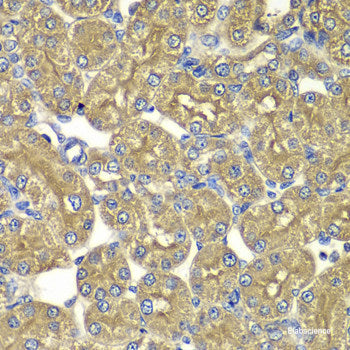
This antibody has been extensively validated for its performance in various applications, including Western blotting, immunohistochemistry, and immunofluorescence. It exhibits exceptional sensitivity and specificity, allowing for precise detection of PSMD5 protein expression even at low levels. Furthermore, the PSMD5 Polyclonal Antibody demonstrates minimal cross-reactivity with other related proteins, ensuring reliable and accurate results.
The PSMD5 Polyclonal Antibody is supplied as a ready-to-use solution, eliminating the need for time-consuming antibody preparation. It is compatible with a wide range of sample types, including cell lysates, tissue extracts, and purified proteins. The antibody is provided in a convenient format, facilitating easy and efficient experimental procedures.
In summary, the PSMD5 Polyclonal Antibody is a highly reliable and specific tool for the detection and analysis of PSMD5 protein expression. Its exceptional sensitivity, minimal cross-reactivity, and compatibility with various applications make it an ideal choice for researchers studying protein degradation and the ubiquitin-proteasome system.
Share