Elabscience
SKU:E-AB-60414
KIR2DL3 Polyclonal Antibody
KIR2DL3 Polyclonal Antibody
Couldn't load pickup availability
KIR2DL3 Polyclonal Antibody
The KIR2DL4 Polyclonal Antibody is a highly specific and reliable tool designed for the detection and analysis of KIR2DL4 protein expression in various biological samples. This antibody is produced using advanced immunization techniques, ensuring high affinity and specificity towards the target protein.
KIR2DL4, also known as CD158d, is a member of the killer cell immunoglobulin-like receptor (KIR) family. It is predominantly expressed on natural killer (NK) cells and plays a crucial role in regulating NK cell function. KIR2DL4 has been implicated in various immune responses, including the recognition and elimination of infected or transformed cells.
The KIR2DL4 Polyclonal Antibody is manufactured using state-of-the-art technology and undergoes rigorous quality control procedures to ensure optimal performance and reproducibility. It has been validated for use in various applications, including Western blotting, immunohistochemistry, and flow cytometry.
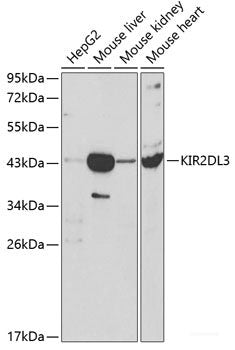
In Western blotting, this antibody exhibits high sensitivity and specificity, enabling the detection of KIR2DL4 protein at low concentrations. It recognizes a single band of the expected molecular weight, confirming its specificity for KIR2DL4. In immunohistochemistry, the KIR2DL4 Polyclonal Antibody provides clear and reliable staining of KIR2DL4 protein in tissue sections, allowing for the localization and characterization of KIR2DL4-expressing cells.
Furthermore, this antibody is compatible with flow cytometry, enabling the quantitative analysis of KIR2DL4 expression on cell surfaces. It can be used to identify and characterize KIR2DL4-positive cells within complex cell populations, providing valuable insights into immune cell subsets and their functional properties.
Overall, the KIR2DL4 Polyclonal Antibody is a valuable tool for researchers studying the role of KIR2DL4 in immune responses and its potential as a therapeutic target. Its high specificity, sensitivity, and versatility make it an essential component of any comprehensive research study involving KIR2DL4 protein analysis.
Share