Elabscience
SKU:E-AB-21540
Phospho-ATM (Ser1981) Polyclonal Antibody
Phospho-ATM (Ser1981) Polyclonal Antibody
Couldn't load pickup availability
Phospho-ATM (Ser1981) Polyclonal Antibody
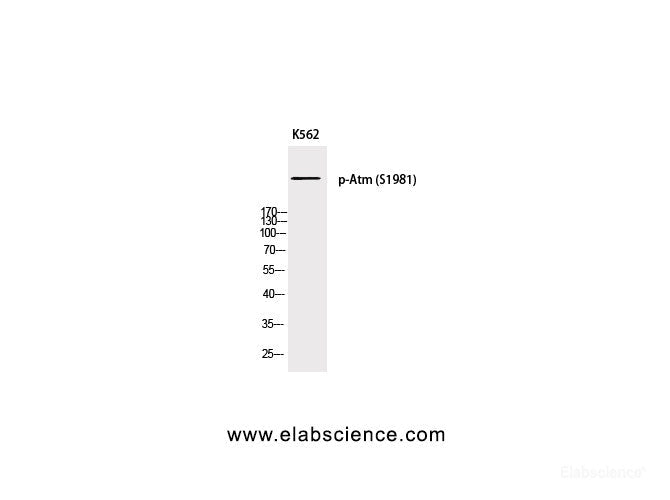
Introducing the Phospho-ATM (Ser1981) Polyclonal Antibody (E-AB-21540) by Dana Biosciences. This meticulously crafted antibody is designed to detect and quantify phosphorylated ataxia telangiectasia mutated (ATM) protein at serine 1981 residue.
The Phospho-ATM (Ser1981) Polyclonal Antibody is a highly specific and sensitive tool for researchers in the field of molecular biology, cellular signaling, and cancer research. It offers exceptional performance in various applications, including Western blotting, immunohistochemistry, and immunofluorescence.
With its superior affinity and selectivity, this antibody enables precise detection and quantification of phosphorylated ATM protein at serine 1981 residue. Its polyclonal nature ensures a broad recognition of the target protein, enhancing the accuracy and reliability of experimental results.
Manufactured with utmost precision and quality, the Phospho-ATM (Ser1981) Polyclonal Antibody exhibits exceptional reproducibility and consistency, ensuring reliable and robust data acquisition. Its optimized formulation guarantees minimal background noise, enabling clear visualization and accurate interpretation of results.
This antibody is supplied in a convenient and user-friendly format, allowing for easy handling and storage. It is provided in a liquid form, eliminating the need for reconstitution, and is compatible with various assay conditions and protocols.
Dana Biosciences takes pride in delivering cutting-edge research tools, and the Phospho-ATM (Ser1981) Polyclonal Antibody is no exception. With its exceptional performance, reliability, and ease of use, it is an indispensable asset for scientists and researchers striving for groundbreaking discoveries in the field of molecular biology and cancer research.
Choose the Phospho-ATM (Ser1981) Polyclonal Antibody by Dana Biosciences and unlock the potential for groundbreaking research in the realm of cellular signaling and cancer biology.
Share