Elabscience
SKU:E-AB-20830
Phospho-Catenin beta (Tyr654) Polyclonal Antibody
Phospho-Catenin beta (Tyr654) Polyclonal Antibody
Couldn't load pickup availability
Phospho-Catenin beta (Tyr654) Polyclonal Antibody
Introducing the Phospho-Catenin Beta Tyr654 Polyclonal Antibody (E-AB-20830) by Dana Biosciences. This meticulously crafted antibody is designed to specifically target and detect the phosphorylated form of Catenin Beta at Tyr654.
Catenin Beta, a key component of the Wnt signaling pathway, plays a crucial role in cell adhesion and gene transcription regulation. Phosphorylation at Tyr654 has been identified as a critical post-translational modification that influences the stability and activity of Catenin Beta, thereby affecting its downstream signaling cascades.
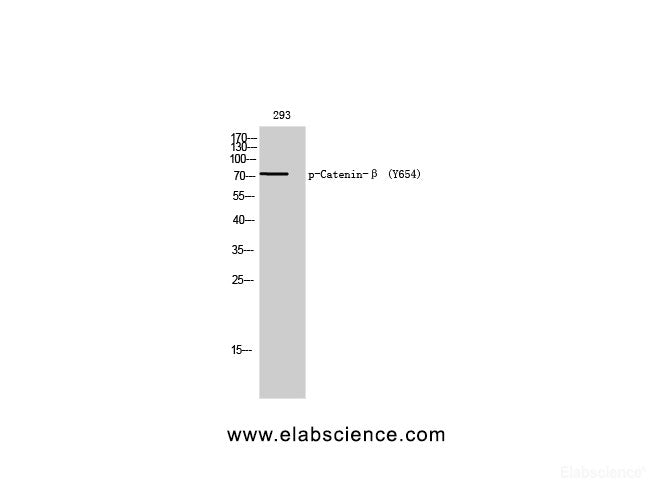
The Phospho-Catenin Beta Tyr654 Polyclonal Antibody (E-AB-20830) exhibits exceptional specificity and sensitivity, enabling precise detection and quantification of phosphorylated Catenin Beta at Tyr654. This antibody has been rigorously validated through various experimental techniques, including Western blotting, immunoprecipitation, and immunofluorescence, ensuring reliable and reproducible results.
With its high affinity and low background, this antibody offers researchers a valuable tool for investigating the intricate mechanisms underlying Wnt signaling and its implications in various biological processes. Its versatility extends to a wide range of applications, including but not limited to, cancer research, developmental biology, and stem cell studies.
Dana Biosciences takes pride in delivering top-quality research reagents, and the Phospho-Catenin Beta Tyr654 Polyclonal Antibody (E-AB-20830) is no exception. Manufactured under stringent quality control measures, this antibody guarantees consistent performance and batch-to-batch reproducibility, ensuring reliable and accurate results in every experiment.
Choose the Phospho-Catenin Beta Tyr654 Polyclonal Antibody (E-AB-20830) from Dana Biosciences to unlock new insights into the intricate world of Wnt signaling and advance your research endeavors.
Share