Elabscience
SKU:E-AB-68159
Phospho-p53(S46) Polyclonal Antibody
Phospho-p53(S46) Polyclonal Antibody
Couldn't load pickup availability
Phospho-p53(S46) Polyclonal Antibody
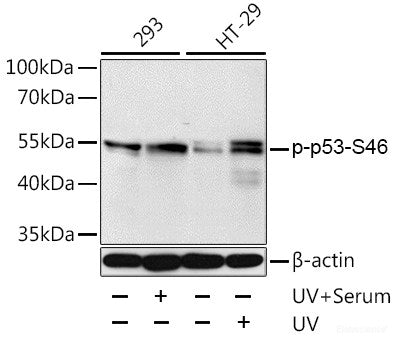
The PHOSPHO-P53(S46) Polyclonal Antibody is a highly specific and reliable tool designed for the detection and analysis of phosphorylated P53 protein at serine 46 residue. This antibody is produced using advanced polyclonal antibody technology, ensuring exceptional sensitivity and specificity in various applications, including Western blotting, immunohistochemistry, and immunofluorescence.
The PHOSPHO-P53(S46) Polyclonal Antibody exhibits outstanding performance in recognizing the phosphorylated form of P53 protein at serine 46, a critical residue involved in the regulation of P53 activity and function. This antibody enables researchers to investigate the phosphorylation status of P53 protein, providing valuable insights into its role in cellular processes such as DNA damage response, cell cycle control, and apoptosis.
With its high affinity and selectivity, the PHOSPHO-P53(S46) Polyclonal Antibody offers reliable and reproducible results, ensuring accurate and precise detection of phosphorylated P53 protein. Its exceptional sensitivity allows for the detection of low-abundance phosphorylated P53 protein, even in complex biological samples.
The PHOSPHO-P53(S46) Polyclonal Antibody is manufactured under strict quality control standards, guaranteeing batch-to-batch consistency and reliability. It is supplied as a ready-to-use solution, eliminating the need for time-consuming antibody preparation. This antibody is compatible with various experimental techniques and can be used in both research and clinical settings.
In summary, the PHOSPHO-P53(S46) Polyclonal Antibody is a highly specific and sensitive tool for the detection and analysis of phosphorylated P53 protein at serine 46 residue. Its exceptional performance, reliability, and ease of use make it an invaluable asset for researchers studying P53 signaling pathways and its implications in various biological processes.
Share