1
/
of
1
Elabscience
SKU:E-EL-M3011
Mouse PRL(Prolactin) ELISA Kit
Mouse PRL(Prolactin) ELISA Kit
Regular price
$609.00 USD
Regular price
Sale price
$609.00 USD
Unit price
/
per
Shipping calculated at checkout.
Couldn't load pickup availability
The Mouse PRL (Prolactin) ELISA Kit is a highly reliable and efficient tool designed for the quantitative measurement of Prolactin levels in mouse serum, plasma, and other biological samples. This kit utilizes a solid-phase sandwich enzyme-linked immunosorbent assay (ELISA) technique, ensuring accurate and precise results.
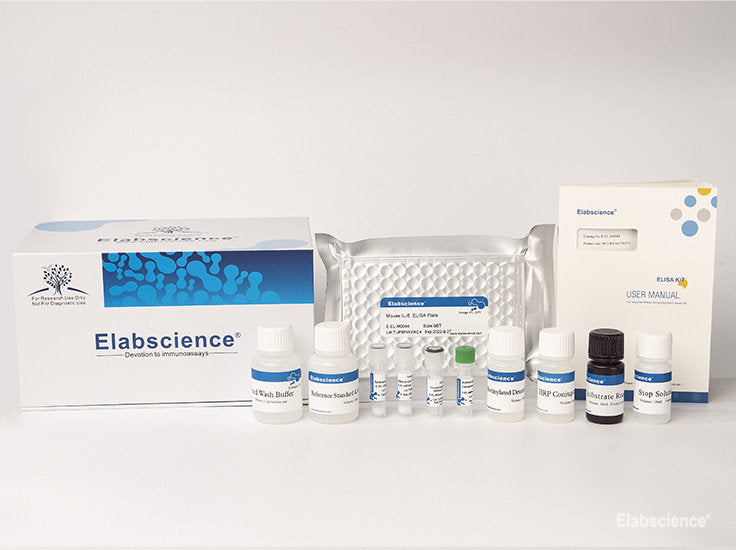
The Mouse PRL ELISA Kit includes all the necessary components for the assay, including pre-coated microplate wells, standards, controls, and detection reagents. The microplate wells are pre-coated with a highly specific monoclonal antibody against Mouse PRL, ensuring high sensitivity and specificity. The standards and controls provided allow for the generation of a standard curve, enabling the quantification of Prolactin levels in the samples.
The assay procedure is simple and straightforward, with a total assay time of approximately 3 hours. The samples and standards are added to the microplate wells, followed by the addition of the detection reagents. After a brief incubation period and washing steps, a substrate solution is added, resulting in the development of a colorimetric reaction. The intensity of the color is directly proportional to the concentration of Prolactin in the samples, which can be measured using a microplate reader at a wavelength of 450 nm.
The Mouse PRL ELISA Kit offers a wide dynamic range, with a lower limit of detection of 0.1 ng/mL. This kit exhibits excellent sensitivity, precision, and accuracy, making it suitable for a variety of research applications. It is particularly useful in studying the role of Prolactin in various physiological and pathological processes, including lactation, reproduction, and immune regulation.
With its high-quality components and reliable performance, the Mouse PRL ELISA Kit is an indispensable tool for researchers and scientists working in the field of endocrinology and related disciplines. It provides a convenient and efficient method for the quantitative determination of Prolactin levels in mouse samples, facilitating valuable insights into the role of Prolactin in biological processes.
The Mouse PRL ELISA Kit includes all the necessary components for the assay, including pre-coated microplate wells, standards, controls, and detection reagents. The microplate wells are pre-coated with a highly specific monoclonal antibody against Mouse PRL, ensuring high sensitivity and specificity. The standards and controls provided allow for the generation of a standard curve, enabling the quantification of Prolactin levels in the samples.
The assay procedure is simple and straightforward, with a total assay time of approximately 3 hours. The samples and standards are added to the microplate wells, followed by the addition of the detection reagents. After a brief incubation period and washing steps, a substrate solution is added, resulting in the development of a colorimetric reaction. The intensity of the color is directly proportional to the concentration of Prolactin in the samples, which can be measured using a microplate reader at a wavelength of 450 nm.
The Mouse PRL ELISA Kit offers a wide dynamic range, with a lower limit of detection of 0.1 ng/mL. This kit exhibits excellent sensitivity, precision, and accuracy, making it suitable for a variety of research applications. It is particularly useful in studying the role of Prolactin in various physiological and pathological processes, including lactation, reproduction, and immune regulation.
With its high-quality components and reliable performance, the Mouse PRL ELISA Kit is an indispensable tool for researchers and scientists working in the field of endocrinology and related disciplines. It provides a convenient and efficient method for the quantitative determination of Prolactin levels in mouse samples, facilitating valuable insights into the role of Prolactin in biological processes.
Share