1
/
of
1
Elabscience
SKU:E-EL-MK2053
Monkey MASP1(Mannan Associated Serine Protease 1) ELISA Kit
Monkey MASP1(Mannan Associated Serine Protease 1) ELISA Kit
Regular price
$682.00 USD
Regular price
Sale price
$682.00 USD
Unit price
/
per
Shipping calculated at checkout.
Couldn't load pickup availability
Introducing the Monkey MASP1 (Mannan Associated Serine Protease 1) ELISA Kit, a cutting-edge solution designed to facilitate accurate and efficient detection of MASP1 in monkey samples. This high-quality kit is meticulously crafted to meet the rigorous demands of scientific research and diagnostic applications.
The Monkey MASP1 ELISA Kit employs the enzyme-linked immunosorbent assay (ELISA) technique, a widely recognized and reliable method for quantifying target proteins. With its exceptional sensitivity and specificity, this kit enables researchers to precisely measure MASP1 levels in monkey samples, providing valuable insights into various biological processes and disease mechanisms.
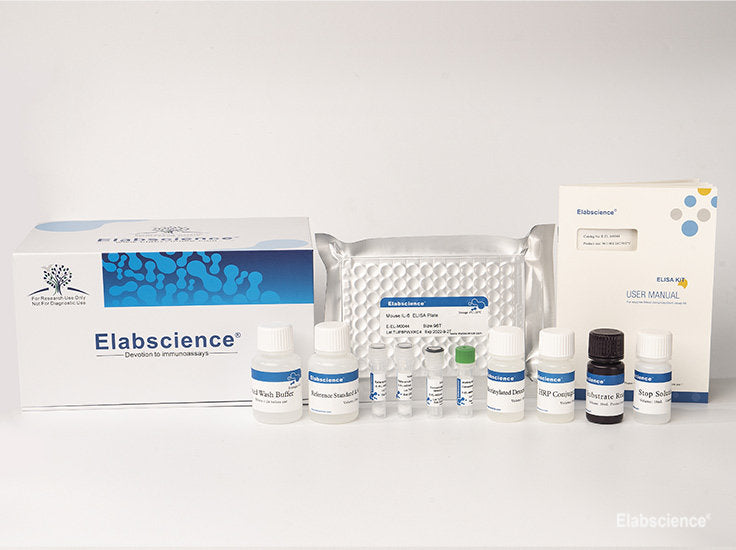
This comprehensive kit includes all the necessary components for a seamless and streamlined experimental workflow. The monoclonal antibodies, meticulously selected for their exceptional affinity and specificity, ensure accurate and reliable detection of MASP1. The pre-coated microplate, coated with the capture antibody, simplifies the assay procedure, saving valuable time and effort.
The Monkey MASP1 ELISA Kit offers a wide dynamic range, allowing for the quantification of MASP1 in a broad concentration range. The kit also boasts an impressive low limit of detection, ensuring the reliable detection of even trace amounts of MASP1 in monkey samples.
With its user-friendly protocol and straightforward instructions, the Monkey MASP1 ELISA Kit is suitable for both experienced researchers and newcomers to the field. The kit's robust performance and reproducibility guarantee consistent and reliable results, enabling researchers to confidently draw conclusions from their experiments.
In summary, the Monkey MASP1 ELISA Kit is a state-of-the-art solution for the accurate and efficient detection of MASP1 in monkey samples. Its exceptional sensitivity, specificity, and user-friendly design make it an indispensable tool for researchers and clinicians alike, facilitating advancements in various fields, including immunology, infectious diseases, and biomarker discovery.
The Monkey MASP1 ELISA Kit employs the enzyme-linked immunosorbent assay (ELISA) technique, a widely recognized and reliable method for quantifying target proteins. With its exceptional sensitivity and specificity, this kit enables researchers to precisely measure MASP1 levels in monkey samples, providing valuable insights into various biological processes and disease mechanisms.
This comprehensive kit includes all the necessary components for a seamless and streamlined experimental workflow. The monoclonal antibodies, meticulously selected for their exceptional affinity and specificity, ensure accurate and reliable detection of MASP1. The pre-coated microplate, coated with the capture antibody, simplifies the assay procedure, saving valuable time and effort.
The Monkey MASP1 ELISA Kit offers a wide dynamic range, allowing for the quantification of MASP1 in a broad concentration range. The kit also boasts an impressive low limit of detection, ensuring the reliable detection of even trace amounts of MASP1 in monkey samples.
With its user-friendly protocol and straightforward instructions, the Monkey MASP1 ELISA Kit is suitable for both experienced researchers and newcomers to the field. The kit's robust performance and reproducibility guarantee consistent and reliable results, enabling researchers to confidently draw conclusions from their experiments.
In summary, the Monkey MASP1 ELISA Kit is a state-of-the-art solution for the accurate and efficient detection of MASP1 in monkey samples. Its exceptional sensitivity, specificity, and user-friendly design make it an indispensable tool for researchers and clinicians alike, facilitating advancements in various fields, including immunology, infectious diseases, and biomarker discovery.
Share