ABCbiolab
SKU:ABCCS00586
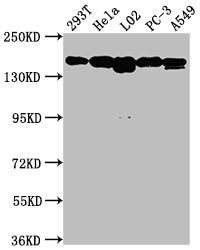
MET Antibody
MET Antibody
Couldn't load pickup availability
Size
100ul
Clone Number
6E5
Aliases
Hepatocyte growth factor receptor (HGF receptor) (EC 2.7.10.1) (HGF/SF receptor) (Proto-oncogene c-Met) (Scatter factor receptor) (SF receptor) (Tyrosine-protein kinase Met), MET
Immunogen Species
Homo sapiens (Human)
UniProt ID
P08581
Immunogen
A synthesized peptide derived from human c-Met
Raised in
Species Reactivity
Human
Tested Applications
ELISA, IHC; Recommended dilution: IHC:1:50-1:200
Background
Receptor tyrosine kinase that transduces signals from the extracellular matrix into the cytoplasm by binding to hepatocyte growth factor/HGF ligand. Regulates many physiological processes including proliferation, scattering, morphogenesis and survival. Ligand binding at the cell surface induces autophosphorylation of MET on its intracellular domain that provides docking sites for downstream signaling molecules. Following activation by ligand, interacts with the PI3-kinase subunit PIK3R1, PLCG1, SRC, GRB2, STAT3 or the adapter GAB1. Recruitment of these downstream effectors by MET leads to the activation of several signaling cascades including the RAS-ERK, PI3 kinase-AKT, or PLCgamma-PKC. The RAS-ERK activation is associated with the morphogenetic effects while PI3K/AKT coordinates prosurvival effects. During embryonic development, MET signaling plays a role in gastrulation, development and migration of muscles and neuronal precursors, angiogenesis and kidney formation. In adults, participates in wound healing as well as organ regeneration and tissue remodeling. Promotes also differentiation and proliferation of hematopoietic cells. May regulate cortical bone osteogenesis (By similarity).
Clonality
Monoclonal
Isotype
Rabbit IgG
Purification Method
Affinity-chromatography
Conjugate
Non-conjugated
Buffer
Rabbit IgG in phosphate buffered saline, pH 7.4, 150mM NaCl, 0.02% sodium azide and 50% glycerol.
Form
Liquid
Stroage
Upon receipt, store at -20°C or -80°C. Avoid repeated freeze.
Target Names
MET
Research Areas
Epigenetics and Nuclear Signaling; Cancer; Signal transduction
Share