ABCbiolab
SKU:ABCCS00249
HDAC3 Antibody
HDAC3 Antibody
Couldn't load pickup availability
Size
100ul
Clone Number
4D4
Aliases
Histone deacetylase 3 (HD3) (EC 3.5.1.98) (RPD3-2) (SMAP45), HDAC3
Immunogen Species
Homo sapiens (Human)
UniProt ID
O15379
Immunogen
A synthesized peptide derived from human HDAC3
Raised in
Species Reactivity
Human
Tested Applications
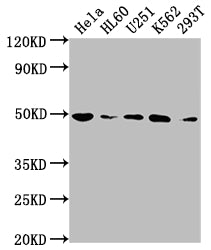
ELISA, WB, IHC; Recommended dilution: WB:1:500-1:5000, IHC:1:50-1:200
Background
Responsible for the deacetylation of lysine residues on the N-terminal part of the core histones (H2A, H2B, H3 and H4), and some other non-histone substrates. Histone deacetylation gives a tag for epigenetic repression and plays an important role in transcriptional regulation, cell cycle progression and developmental events. Histone deacetylases act via the formation of large multiprotein complexes. Participates in the BCL6 transcriptional repressor activity by deacetylating the H3 'Lys-27' (H3K27) on enhancer elements, antagonizing EP300 acetyltransferase activity and repressing proximal gene expression. Probably participates in the regulation of transcription through its binding to the zinc-finger transcription factor YY1; increases YY1 repression activity. Required to repress transcription of the POU1F1 transcription factor. Acts as a molecular chaperone for shuttling phosphorylated NR2C1 to PML bodies for sumoylation (PubMed:21444723, PubMed:23911289). Contributes, together with XBP1 isoform 1, to the activation of NFE2L2-mediated HMOX1 transcription factor gene expression in a PI(3)K/mTORC2/Akt-dependent signaling pathway leading to endothelial cell (EC) survival under disturbed flow/oxidative stress (PubMed:25190803).
Clonality
Monoclonal
Isotype
Rabbit IgG
Purification Method
Affinity-chromatography
Conjugate
Non-conjugated
Buffer
Rabbit IgG in phosphate buffered saline, pH 7.4, 150mM NaCl, 0.02% sodium azide and 50% glycerol.
Form
Liquid
Stroage
Upon receipt, store at -20°C or -80°C. Avoid repeated freeze.
Target Names
HDAC3
Research Areas
Epigenetics and Nuclear Signaling; Cancer; Cardiovascular; Metabolism; Stem cells
Share