1
/
of
1
ELK Biotechnology
SKU:ES9684
GCH1 rabbit pAb
GCH1 rabbit pAb
Regular price
$250.00 USD
Regular price
Sale price
$250.00 USD
Unit price
/
per
Shipping calculated at checkout.
Couldn't load pickup availability
Applications: WB;ELISA
Reactivity: Human;Mouse;Rat
Source: Rabbit
Dilution: WB 1:500-2000 ELISA 1:5000-20000
Immunogen: Synthesized peptide derived from part region of human protein
Storage_stability: -20°C/1 year
Clonality: Polyclonal
Isotype: IgG
Concentration: 1 mg/ml
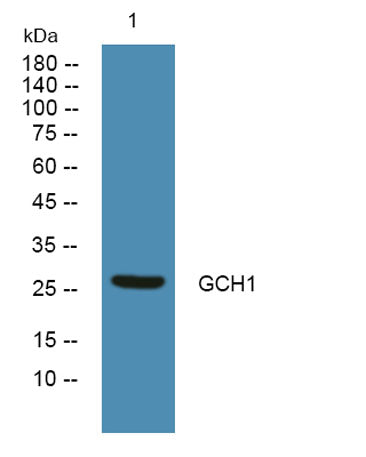
Observed_band(KD): 27kD
Human_gene_id: 2643
Human_swiss_prot_no: P30793
Subcellular_location: Cytoplasm . Nucleus .
Background: This gene encodes a member of the GTP cyclohydrolase family. The encoded protein is the first and rate-limiting enzyme in tetrahydrobiopterin (BH4) biosynthesis, catalyzing the conversion of GTP into 7,8-dihydroneopterin triphosphate. BH4 is an essential cofactor required by aromatic amino acid hydroxylases as well as nitric oxide synthases. Mutations in this gene are associated with malignant hyperphenylalaninemia and dopa-responsive dystonia. Several alternatively spliced transcript variants encoding different isoforms have been described; however, not all variants give rise to a functional enzyme. [provided by RefSeq, Jul 2008],
Reactivity: Human;Mouse;Rat
Source: Rabbit
Dilution: WB 1:500-2000 ELISA 1:5000-20000
Immunogen: Synthesized peptide derived from part region of human protein
Storage_stability: -20°C/1 year
Clonality: Polyclonal
Isotype: IgG
Concentration: 1 mg/ml
Observed_band(KD): 27kD
Human_gene_id: 2643
Human_swiss_prot_no: P30793
Subcellular_location: Cytoplasm . Nucleus .
Background: This gene encodes a member of the GTP cyclohydrolase family. The encoded protein is the first and rate-limiting enzyme in tetrahydrobiopterin (BH4) biosynthesis, catalyzing the conversion of GTP into 7,8-dihydroneopterin triphosphate. BH4 is an essential cofactor required by aromatic amino acid hydroxylases as well as nitric oxide synthases. Mutations in this gene are associated with malignant hyperphenylalaninemia and dopa-responsive dystonia. Several alternatively spliced transcript variants encoding different isoforms have been described; however, not all variants give rise to a functional enzyme. [provided by RefSeq, Jul 2008],
Share