1
/
of
1
ELK Biotechnology
SKU:ES9551
CLD9 rabbit pAb
CLD9 rabbit pAb
Regular price
$250.00 USD
Regular price
Sale price
$250.00 USD
Unit price
/
per
Shipping calculated at checkout.
Couldn't load pickup availability
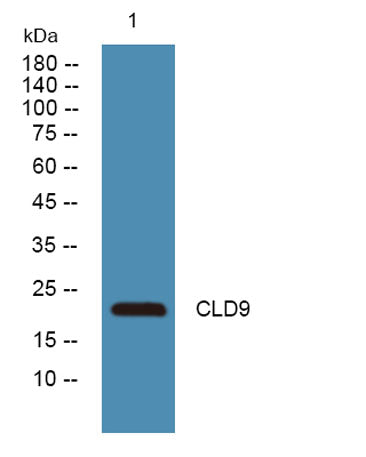
Applications: WB;ELISA
Reactivity: Human;Mouse
Source: Rabbit
Dilution: WB 1:500-2000 ELISA 1:5000-20000
Immunogen: Synthesized peptide derived from part region of human protein
Storage_stability: -20°C/1 year
Clonality: Polyclonal
Isotype: IgG
Concentration: 1 mg/ml
Observed_band(KD): 23kD
Human_gene_id: 9080
Human_swiss_prot_no: O95484
Subcellular_location: Cell junction, tight junction. Cell membrane ; Multi-pass membrane protein .
Background: This gene encodes a member of the claudin family. Claudins are integral membrane proteins and components of tight junction strands. Tight junction strands serve as a physical barrier to prevent solutes and water from passing freely through the paracellular space between epithelial or endothelial cell sheets, and also play critical roles in maintaining cell polarity and signal transductions. This protein is one of the entry cofactors for hepatitis C virus. Mouse studies revealed that this gene is required for the preservation of sensory cells in the hearing organ and the gene deficiency is associated with deafness. [provided by RefSeq, Jun 2010],
Reactivity: Human;Mouse
Source: Rabbit
Dilution: WB 1:500-2000 ELISA 1:5000-20000
Immunogen: Synthesized peptide derived from part region of human protein
Storage_stability: -20°C/1 year
Clonality: Polyclonal
Isotype: IgG
Concentration: 1 mg/ml
Observed_band(KD): 23kD
Human_gene_id: 9080
Human_swiss_prot_no: O95484
Subcellular_location: Cell junction, tight junction. Cell membrane ; Multi-pass membrane protein .
Background: This gene encodes a member of the claudin family. Claudins are integral membrane proteins and components of tight junction strands. Tight junction strands serve as a physical barrier to prevent solutes and water from passing freely through the paracellular space between epithelial or endothelial cell sheets, and also play critical roles in maintaining cell polarity and signal transductions. This protein is one of the entry cofactors for hepatitis C virus. Mouse studies revealed that this gene is required for the preservation of sensory cells in the hearing organ and the gene deficiency is associated with deafness. [provided by RefSeq, Jun 2010],
Share