1
/
of
1
ELK Biotechnology
SKU:ES9457
UCP5 rabbit pAb
UCP5 rabbit pAb
Regular price
$250.00 USD
Regular price
Sale price
$250.00 USD
Unit price
/
per
Shipping calculated at checkout.
Couldn't load pickup availability
Applications: WB;ELISA
Reactivity: Human;Mouse
Source: Rabbit
Dilution: WB 1:500-2000 ELISA 1:5000-20000
Immunogen: Synthesized peptide derived from part region of human protein
Storage_stability: -20°C/1 year
Clonality: Polyclonal
Isotype: IgG
Concentration: 1 mg/ml
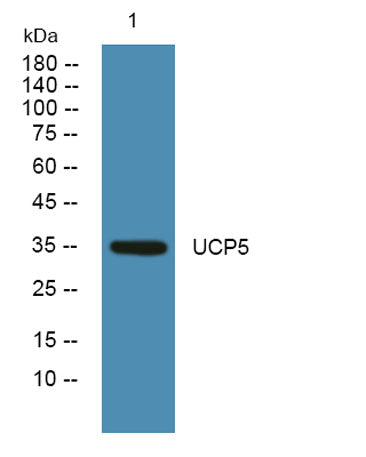
Observed_band(KD): 35kD
Human_gene_id: 9016
Human_swiss_prot_no: O95258
Subcellular_location: Mitochondrion inner membrane ; Multi-pass membrane protein .
Background: Mitochondrial uncoupling proteins (UCP) are members of the larger family of mitochondrial anion carrier proteins (MACP). Uncoupling proteins separate oxidative phosphorylation from ATP synthesis with energy dissipated as heat, also referred to as the mitochondrial proton leak. Uncoupling proteins facilitate the transfer of anions from the inner to the outer mitochondrial membrane and the return transfer of protons from the outer to the inner mitochondrial membrane. They also reduce the mitochondrial membrane potential in mammalian cells. This gene is widely expressed in many tissues with the greatest abundance in brain and testis. Alternative splicing results in multiple transcript variants. A pseudogene of this gene has been defined on chromosome 4. [provided by RefSeq, Aug 2013],
Reactivity: Human;Mouse
Source: Rabbit
Dilution: WB 1:500-2000 ELISA 1:5000-20000
Immunogen: Synthesized peptide derived from part region of human protein
Storage_stability: -20°C/1 year
Clonality: Polyclonal
Isotype: IgG
Concentration: 1 mg/ml
Observed_band(KD): 35kD
Human_gene_id: 9016
Human_swiss_prot_no: O95258
Subcellular_location: Mitochondrion inner membrane ; Multi-pass membrane protein .
Background: Mitochondrial uncoupling proteins (UCP) are members of the larger family of mitochondrial anion carrier proteins (MACP). Uncoupling proteins separate oxidative phosphorylation from ATP synthesis with energy dissipated as heat, also referred to as the mitochondrial proton leak. Uncoupling proteins facilitate the transfer of anions from the inner to the outer mitochondrial membrane and the return transfer of protons from the outer to the inner mitochondrial membrane. They also reduce the mitochondrial membrane potential in mammalian cells. This gene is widely expressed in many tissues with the greatest abundance in brain and testis. Alternative splicing results in multiple transcript variants. A pseudogene of this gene has been defined on chromosome 4. [provided by RefSeq, Aug 2013],
Share