1
/
of
1
ELK Biotechnology
SKU:ES9267
ACL6B rabbit pAb
ACL6B rabbit pAb
Regular price
$250.00 USD
Regular price
Sale price
$250.00 USD
Unit price
/
per
Shipping calculated at checkout.
Couldn't load pickup availability
Applications: WB;ELISA
Reactivity: Human;Mouse
Source: Rabbit
Dilution: WB 1:500-2000 ELISA 1:5000-20000
Immunogen: Synthesized peptide derived from human protein . at AA range: 1-80
Storage_stability: -20°C/1 year
Clonality: Polyclonal
Isotype: IgG
Concentration: 1 mg/ml
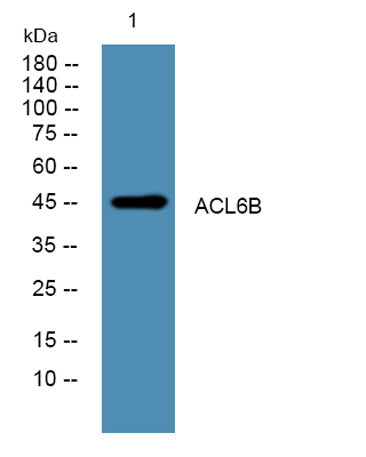
Observed_band(KD): 46kD
Human_gene_id: 51412
Human_swiss_prot_no: O94805
Subcellular_location: Nucleus .
Background: The protein encoded by this gene is a member of a family of actin-related proteins (ARPs) which share significant amino acid sequence identity to conventional actins. Both actins and ARPs have an actin fold, which is an ATP-binding cleft, as a common feature. The ARPs are involved in diverse cellular processes, including vesicular transport, spindle orientation, nuclear migration and chromatin remodeling. This gene encodes a subunit of the BAF (BRG1/brm-associated factor) complex in mammals, which is functionally related to SWI/SNF complex in S. cerevisiae and Drosophila; the latter is thought to facilitate transcriptional activation of specific genes by antagonizing chromatin-mediated transcriptional repression. This subunit may be involved in the regulation of genes by structural modulation of their chromatin, specifically in the brain. Alternative splicing results in multiple transcript variants. [provid
Reactivity: Human;Mouse
Source: Rabbit
Dilution: WB 1:500-2000 ELISA 1:5000-20000
Immunogen: Synthesized peptide derived from human protein . at AA range: 1-80
Storage_stability: -20°C/1 year
Clonality: Polyclonal
Isotype: IgG
Concentration: 1 mg/ml
Observed_band(KD): 46kD
Human_gene_id: 51412
Human_swiss_prot_no: O94805
Subcellular_location: Nucleus .
Background: The protein encoded by this gene is a member of a family of actin-related proteins (ARPs) which share significant amino acid sequence identity to conventional actins. Both actins and ARPs have an actin fold, which is an ATP-binding cleft, as a common feature. The ARPs are involved in diverse cellular processes, including vesicular transport, spindle orientation, nuclear migration and chromatin remodeling. This gene encodes a subunit of the BAF (BRG1/brm-associated factor) complex in mammals, which is functionally related to SWI/SNF complex in S. cerevisiae and Drosophila; the latter is thought to facilitate transcriptional activation of specific genes by antagonizing chromatin-mediated transcriptional repression. This subunit may be involved in the regulation of genes by structural modulation of their chromatin, specifically in the brain. Alternative splicing results in multiple transcript variants. [provid
Share