1
/
of
1
ELK Biotechnology
SKU:ES9134
CRLF3 rabbit pAb
CRLF3 rabbit pAb
Regular price
$250.00 USD
Regular price
Sale price
$250.00 USD
Unit price
/
per
Shipping calculated at checkout.
Couldn't load pickup availability
Applications: WB;ELISA
Reactivity: Human;Mouse
Source: Rabbit
Dilution: WB 1:500-2000 ELISA 1:5000-20000
Immunogen: Synthesized peptide derived from human protein . at AA range: 270-350
Storage_stability: -20°C/1 year
Clonality: Polyclonal
Isotype: IgG
Concentration: 1 mg/ml
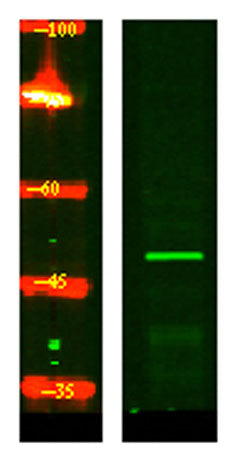
Observed_band(KD): 48kD
Human_gene_id: 51379
Human_swiss_prot_no: Q8IUI8
Subcellular_location: Cytoplasm . The EGFP- and MYC-tagged protein has been shown to be cytoplasmic. .
Background: This gene encodes a cytokine receptor-like factor that may negatively regulate cell cycle progression at the G0/G1 phase. Studies of the related rat protein suggest that it may regulate neuronal morphology and synaptic vesicle biogenesis. This gene is one of several genes located in the neurofibromatosis type I tumor suppressor region on the q arm of chromosome 17, a region that is subject to microdeletions, duplications, chromosomal breaks and rearrangements. Alternative splicing of this gene results in multiple transcript variants. Related pseudogenes have been identified on chromosomes 2 and 5. [provided by RefSeq, Aug 2012],
Reactivity: Human;Mouse
Source: Rabbit
Dilution: WB 1:500-2000 ELISA 1:5000-20000
Immunogen: Synthesized peptide derived from human protein . at AA range: 270-350
Storage_stability: -20°C/1 year
Clonality: Polyclonal
Isotype: IgG
Concentration: 1 mg/ml
Observed_band(KD): 48kD
Human_gene_id: 51379
Human_swiss_prot_no: Q8IUI8
Subcellular_location: Cytoplasm . The EGFP- and MYC-tagged protein has been shown to be cytoplasmic. .
Background: This gene encodes a cytokine receptor-like factor that may negatively regulate cell cycle progression at the G0/G1 phase. Studies of the related rat protein suggest that it may regulate neuronal morphology and synaptic vesicle biogenesis. This gene is one of several genes located in the neurofibromatosis type I tumor suppressor region on the q arm of chromosome 17, a region that is subject to microdeletions, duplications, chromosomal breaks and rearrangements. Alternative splicing of this gene results in multiple transcript variants. Related pseudogenes have been identified on chromosomes 2 and 5. [provided by RefSeq, Aug 2012],
Share