1
/
of
1
ELK Biotechnology
SKU:ES8796
CD275 rabbit pAb
CD275 rabbit pAb
Regular price
$250.00 USD
Regular price
Sale price
$250.00 USD
Unit price
/
per
Shipping calculated at checkout.
Couldn't load pickup availability
Applications: IHC;IF;ELISA
Reactivity: Human;Rat;Mouse;
Source: Rabbit
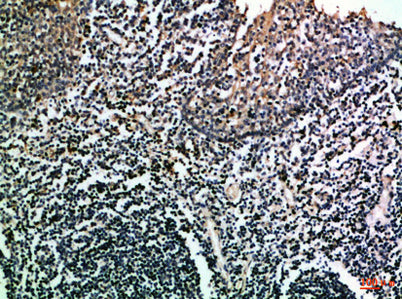
Dilution: IHC-p 1:50-200, ELISA 1:10000-20000
Immunogen: Synthetic peptide from human protein at AA range: 201-250
Storage_stability: -20°C/1 year
Clonality: Polyclonal
Isotype: IgG
Concentration: 1 mg/ml
Human_gene_id: 23308
Human_swiss_prot_no: O75144
Subcellular_location: Cell membrane ; Single-pass type I membrane protein .
Other_name: ICOS ligand (B7 homolog 2;B7-H2;B7-like protein Gl50;B7-related protein 1;B7RP-1;CD antigen CD275)
Background: alternative products:Additional isoforms seem to exist,function:Ligand for the T-cell-specific cell surface receptor ICOS. Acts as a costimulatory signal for T-cell proliferation and cytokine secretion; induces also B-cell proliferation and differentiation into plasma cells. Could play an important role in mediating local tissue responses to inflammatory conditions, as well as in modulating the secondary immune response by co-stimulating memory T-cell function.,induction:Constitutive expression is further enhanced by treatment with TNF-alpha in peripheral blood B-cells and monocytes, while it is decreased in dendritic cells.,sequence caution:The sequence differs from that shown in position 300 onward for unknown reason.,sequence caution:Translation N-terminally shortened.,similarity:Belongs to the immunoglobulin superfamily. BTN/MOG family.,similarity:Contains 1 Ig-like C2-type (immunoglobulin-like) domain.,similarity:Contains 1 Ig-like V-type (immunoglobulin-like) domain.,tissue specificity:Isoform 1 is widely expressed (brain, heart, kidney, liver, lung, pancreas, placenta, skeletal muscle, bone marrow, colon, ovary, prostate, testis, lymph nodes, leukocytes, spleen, thymus and tonsil), while isoform 2 is detected only in lymph nodes, leukocytes and spleen. Expressed on activated monocytes and dendritic cells.,
Reactivity: Human;Rat;Mouse;
Source: Rabbit
Dilution: IHC-p 1:50-200, ELISA 1:10000-20000
Immunogen: Synthetic peptide from human protein at AA range: 201-250
Storage_stability: -20°C/1 year
Clonality: Polyclonal
Isotype: IgG
Concentration: 1 mg/ml
Human_gene_id: 23308
Human_swiss_prot_no: O75144
Subcellular_location: Cell membrane ; Single-pass type I membrane protein .
Other_name: ICOS ligand (B7 homolog 2;B7-H2;B7-like protein Gl50;B7-related protein 1;B7RP-1;CD antigen CD275)
Background: alternative products:Additional isoforms seem to exist,function:Ligand for the T-cell-specific cell surface receptor ICOS. Acts as a costimulatory signal for T-cell proliferation and cytokine secretion; induces also B-cell proliferation and differentiation into plasma cells. Could play an important role in mediating local tissue responses to inflammatory conditions, as well as in modulating the secondary immune response by co-stimulating memory T-cell function.,induction:Constitutive expression is further enhanced by treatment with TNF-alpha in peripheral blood B-cells and monocytes, while it is decreased in dendritic cells.,sequence caution:The sequence differs from that shown in position 300 onward for unknown reason.,sequence caution:Translation N-terminally shortened.,similarity:Belongs to the immunoglobulin superfamily. BTN/MOG family.,similarity:Contains 1 Ig-like C2-type (immunoglobulin-like) domain.,similarity:Contains 1 Ig-like V-type (immunoglobulin-like) domain.,tissue specificity:Isoform 1 is widely expressed (brain, heart, kidney, liver, lung, pancreas, placenta, skeletal muscle, bone marrow, colon, ovary, prostate, testis, lymph nodes, leukocytes, spleen, thymus and tonsil), while isoform 2 is detected only in lymph nodes, leukocytes and spleen. Expressed on activated monocytes and dendritic cells.,
Share