1
/
of
1
ELK Biotechnology
SKU:ES8431
14-3-3-pan (Acetyl Lys51/49) rabbit pAb
14-3-3-pan (Acetyl Lys51/49) rabbit pAb
Regular price
$250.00 USD
Regular price
Sale price
$250.00 USD
Unit price
/
per
Shipping calculated at checkout.
Couldn't load pickup availability
Applications: WB;ELISA
Reactivity: Human;Mouse;Rat
Source: Rabbit
Dilution: Western Blot: 1/500 - 1/2000. ELISA: 1/10000. Not yet tested in other applications.
Immunogen: Synthesized acetyl-peptide derived from human 14-3-3-pan around the acetylation site of K51.
Storage_stability: -20°C/1 year
Clonality: Polyclonal
Isotype: IgG
Concentration: 1 mg/ml
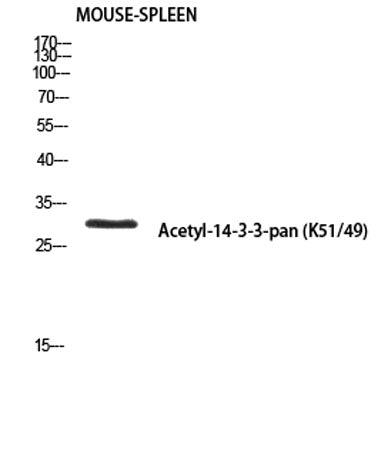
Observed_band(KD): 30kD
Human_gene_id: 7529
Human_swiss_prot_no: P31946
Subcellular_location: Cytoplasm . Melanosome . Identified by mass spectrometry in melanosome fractions from stage I to stage IV.; Vacuole membrane . (Microbial infection) Upon infection with Chlamydia trachomatis, this protein is associated with the pathogen-containing vacuole membrane where it colocalizes with IncG. .
Other_name: YWHAB; 14-3-3 protein beta/alpha; Protein 1054; Protein kinase C inhibitor protein 1; KCIP-1; YWHAG; 14-3-3 protein gamma; Protein kinase C inhibitor protein 1; KCIP-1; YWHAQ; 14-3-3 protein theta; 14-3-3 protein T-cell; 14-3-3 protein tau; Protein HS1; YWHAZ; 14-3-3 protein zeta/delta; Protein kinase C inhibitor protein 1; KCIP-1; SFN; HME1; 14-3-3 protein sigma; Epithelial cell marker protein 1; Stratifin
Background: This gene encodes a protein belonging to the 14-3-3 family of proteins, members of which mediate signal transduction by binding to phosphoserine-containing proteins. This highly conserved protein family is found in both plants and mammals. The encoded protein has been shown to interact with RAF1 and CDC25 phosphatases, suggesting that it may play a role in linking mitogenic signaling and the cell cycle machinery. Two transcript variants, which encode the same protein, have been identified for this gene. [provided by RefSeq, Jul 2008],
Reactivity: Human;Mouse;Rat
Source: Rabbit
Dilution: Western Blot: 1/500 - 1/2000. ELISA: 1/10000. Not yet tested in other applications.
Immunogen: Synthesized acetyl-peptide derived from human 14-3-3-pan around the acetylation site of K51.
Storage_stability: -20°C/1 year
Clonality: Polyclonal
Isotype: IgG
Concentration: 1 mg/ml
Observed_band(KD): 30kD
Human_gene_id: 7529
Human_swiss_prot_no: P31946
Subcellular_location: Cytoplasm . Melanosome . Identified by mass spectrometry in melanosome fractions from stage I to stage IV.; Vacuole membrane . (Microbial infection) Upon infection with Chlamydia trachomatis, this protein is associated with the pathogen-containing vacuole membrane where it colocalizes with IncG. .
Other_name: YWHAB; 14-3-3 protein beta/alpha; Protein 1054; Protein kinase C inhibitor protein 1; KCIP-1; YWHAG; 14-3-3 protein gamma; Protein kinase C inhibitor protein 1; KCIP-1; YWHAQ; 14-3-3 protein theta; 14-3-3 protein T-cell; 14-3-3 protein tau; Protein HS1; YWHAZ; 14-3-3 protein zeta/delta; Protein kinase C inhibitor protein 1; KCIP-1; SFN; HME1; 14-3-3 protein sigma; Epithelial cell marker protein 1; Stratifin
Background: This gene encodes a protein belonging to the 14-3-3 family of proteins, members of which mediate signal transduction by binding to phosphoserine-containing proteins. This highly conserved protein family is found in both plants and mammals. The encoded protein has been shown to interact with RAF1 and CDC25 phosphatases, suggesting that it may play a role in linking mitogenic signaling and the cell cycle machinery. Two transcript variants, which encode the same protein, have been identified for this gene. [provided by RefSeq, Jul 2008],
Share