1
/
of
1
ELK Biotechnology
SKU:ES8395
CD158e rabbit pAb
CD158e rabbit pAb
Regular price
$250.00 USD
Regular price
Sale price
$250.00 USD
Unit price
/
per
Shipping calculated at checkout.
Couldn't load pickup availability
Applications: WB;IHC;IF;ELISA
Reactivity: Human;Rat;Mouse;
Source: Rabbit
Dilution: Western Blot: 1/500 - 1/2000. IHC-p: 1:100-1:300. ELISA: 1/10000. Not yet tested in other applications.
Immunogen: Synthesized peptide derived from Killer cell immunoglobulin-like receptor 3DL1 at AA range: 21-70
Storage_stability: -20°C/1 year
Clonality: Polyclonal
Isotype: IgG
Concentration: 1 mg/ml
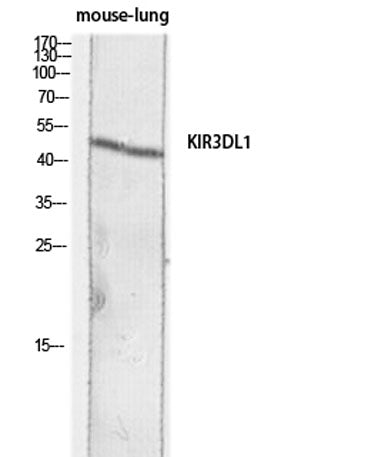
Observed_band(KD): 50kD
Human_gene_id: 3811
Human_swiss_prot_no: P43629
Subcellular_location: Cell membrane; Single-pass type I membrane protein.
Other_name: KIR3DL1; CD158E; NKAT3; NKB1; Killer cell immunoglobulin-like receptor 3DL1; CD158 antigen-like family member E; HLA-BW4-specific inhibitory NK cell receptor; MHC class I NK cell receptor; Natural killer-associated transcript 3; NKAT-3; p70 natural killer cell receptor clones CL-2/CL-11; p70 NK receptor CL-2/CL-11; CD158e
Background: killer cell immunoglobulin like receptor, three Ig domains and long cytoplasmic tail 1(KIR3DL1) Homo sapiens Killer cell immunoglobulin-like receptors (KIRs) are transmembrane glycoproteins expressed by natural killer cells and subsets of T cells. The KIR genes are polymorphic and highly homologous and they are found in a cluster on chromosome 19q13.4 within the 1 Mb leukocyte receptor complex (LRC). The gene content of the KIR gene cluster varies among haplotypes, although several "framework" genes are found in all haplotypes (KIR3DL3, KIR3DP1, KIR3DL4, KIR3DL2). The KIR proteins are classified by the number of extracellular immunoglobulin domains (2D or 3D) and by whether they have a long (L) or short (S) cytoplasmic domain. KIR proteins with the long cytoplasmic domain transduce inhibitory signals upon ligand binding via an immune tyrosine-based inhibitory motif (ITIM), while KIR proteins with the short cytoplasmic domain lack the
Reactivity: Human;Rat;Mouse;
Source: Rabbit
Dilution: Western Blot: 1/500 - 1/2000. IHC-p: 1:100-1:300. ELISA: 1/10000. Not yet tested in other applications.
Immunogen: Synthesized peptide derived from Killer cell immunoglobulin-like receptor 3DL1 at AA range: 21-70
Storage_stability: -20°C/1 year
Clonality: Polyclonal
Isotype: IgG
Concentration: 1 mg/ml
Observed_band(KD): 50kD
Human_gene_id: 3811
Human_swiss_prot_no: P43629
Subcellular_location: Cell membrane; Single-pass type I membrane protein.
Other_name: KIR3DL1; CD158E; NKAT3; NKB1; Killer cell immunoglobulin-like receptor 3DL1; CD158 antigen-like family member E; HLA-BW4-specific inhibitory NK cell receptor; MHC class I NK cell receptor; Natural killer-associated transcript 3; NKAT-3; p70 natural killer cell receptor clones CL-2/CL-11; p70 NK receptor CL-2/CL-11; CD158e
Background: killer cell immunoglobulin like receptor, three Ig domains and long cytoplasmic tail 1(KIR3DL1) Homo sapiens Killer cell immunoglobulin-like receptors (KIRs) are transmembrane glycoproteins expressed by natural killer cells and subsets of T cells. The KIR genes are polymorphic and highly homologous and they are found in a cluster on chromosome 19q13.4 within the 1 Mb leukocyte receptor complex (LRC). The gene content of the KIR gene cluster varies among haplotypes, although several "framework" genes are found in all haplotypes (KIR3DL3, KIR3DP1, KIR3DL4, KIR3DL2). The KIR proteins are classified by the number of extracellular immunoglobulin domains (2D or 3D) and by whether they have a long (L) or short (S) cytoplasmic domain. KIR proteins with the long cytoplasmic domain transduce inhibitory signals upon ligand binding via an immune tyrosine-based inhibitory motif (ITIM), while KIR proteins with the short cytoplasmic domain lack the
Share