1
/
of
1
ELK Biotechnology
SKU:ES8073
RIN1 rabbit pAb
RIN1 rabbit pAb
Regular price
$250.00 USD
Regular price
Sale price
$250.00 USD
Unit price
/
per
Shipping calculated at checkout.
Couldn't load pickup availability
Applications: WB;ELISA;IHC
Reactivity: Human;Mouse;Rat
Source: Rabbit
Dilution: WB 1:500-2000;IHC-p 1:50-300; ELISA 2000-20000
Immunogen: The antiserum was produced against synthesized peptide derived from human RIN1. AA range:655-704
Storage_stability: -20°C/1 year
Clonality: Polyclonal
Isotype: IgG
Concentration: 1 mg/ml
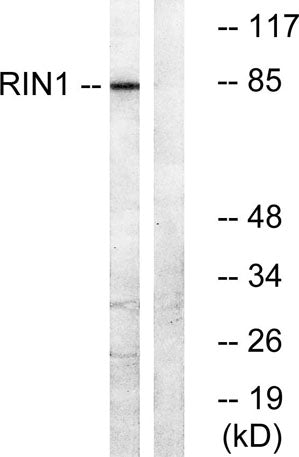
Observed_band(KD): 84kD
Human_gene_id: 9610
Human_swiss_prot_no: Q13671
Subcellular_location: Cytoplasm . Membrane . Cytoplasm, cytoskeleton . Some amount is membrane-associated.
Other_name: RIN1; Ras and Rab interactor 1; Ras inhibitor JC99; Ras interaction/interference protein 1
Background: function:Ras effector protein, which may serve as an inhibitory modulator of neuronal plasticity in aversive memory formation. Can affect Ras signaling at different levels. First, by competing with RAF1 protein for binding to activated Ras. Second, by enhancing signaling from ABL1 and ABL2, which regulate cytoskeletal remodeling. Third, by activating RAB5A, possibly by functioning as a guanine nucleotide exchange factor (GEF) for RAB5A, by exchanging bound GDP for free GTP, and facilitating Ras-activated receptor endocytosis.,PTM:Phosphorylated on tyrosine residues by ABL1 and ABL2. Phosphorylated on Ser-351 by PKD.,similarity:Belongs to the RIN (Ras interaction/interference) family.,similarity:Contains 1 Ras-associating domain.,similarity:Contains 1 SH2 domain.,similarity:Contains 1 VPS9 domain.,subcellular location:Some amount is membrane-associated.,subunit:Interacts with the GTP-bound form of Ras proteins (NRAS, HRAS and KRAS). This interaction prevents the association between RAF1 and Ras. Interacts with 14-3-3 proteins YWHAB, YWHAE and YWHAZ when phosphorylated on Ser-351. Interacts with the SH3 domain of ABL1 and ABL2. Interacts with RAB5A. The interaction with Ras is probably regulated and antagonized by the interaction with 14-3-3 proteins. The interaction with 14-3-3 proteins is regulated by phosphorylation on Ser-351.,tissue specificity:Expressed in all tissues examined with high levels in brain, placenta and pancreas.,
Reactivity: Human;Mouse;Rat
Source: Rabbit
Dilution: WB 1:500-2000;IHC-p 1:50-300; ELISA 2000-20000
Immunogen: The antiserum was produced against synthesized peptide derived from human RIN1. AA range:655-704
Storage_stability: -20°C/1 year
Clonality: Polyclonal
Isotype: IgG
Concentration: 1 mg/ml
Observed_band(KD): 84kD
Human_gene_id: 9610
Human_swiss_prot_no: Q13671
Subcellular_location: Cytoplasm . Membrane . Cytoplasm, cytoskeleton . Some amount is membrane-associated.
Other_name: RIN1; Ras and Rab interactor 1; Ras inhibitor JC99; Ras interaction/interference protein 1
Background: function:Ras effector protein, which may serve as an inhibitory modulator of neuronal plasticity in aversive memory formation. Can affect Ras signaling at different levels. First, by competing with RAF1 protein for binding to activated Ras. Second, by enhancing signaling from ABL1 and ABL2, which regulate cytoskeletal remodeling. Third, by activating RAB5A, possibly by functioning as a guanine nucleotide exchange factor (GEF) for RAB5A, by exchanging bound GDP for free GTP, and facilitating Ras-activated receptor endocytosis.,PTM:Phosphorylated on tyrosine residues by ABL1 and ABL2. Phosphorylated on Ser-351 by PKD.,similarity:Belongs to the RIN (Ras interaction/interference) family.,similarity:Contains 1 Ras-associating domain.,similarity:Contains 1 SH2 domain.,similarity:Contains 1 VPS9 domain.,subcellular location:Some amount is membrane-associated.,subunit:Interacts with the GTP-bound form of Ras proteins (NRAS, HRAS and KRAS). This interaction prevents the association between RAF1 and Ras. Interacts with 14-3-3 proteins YWHAB, YWHAE and YWHAZ when phosphorylated on Ser-351. Interacts with the SH3 domain of ABL1 and ABL2. Interacts with RAB5A. The interaction with Ras is probably regulated and antagonized by the interaction with 14-3-3 proteins. The interaction with 14-3-3 proteins is regulated by phosphorylation on Ser-351.,tissue specificity:Expressed in all tissues examined with high levels in brain, placenta and pancreas.,
Share