1
/
of
1
ELK Biotechnology
SKU:ES8070
AKAP 250 rabbit pAb
AKAP 250 rabbit pAb
Regular price
$250.00 USD
Regular price
Sale price
$250.00 USD
Unit price
/
per
Shipping calculated at checkout.
Couldn't load pickup availability
Applications: IHC;IF;ELISA
Reactivity: Human;Rat;Mouse;
Source: Rabbit
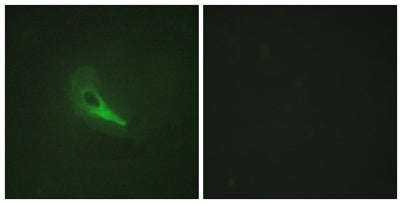
Dilution: Immunohistochemistry: 1/100 - 1/300. Immunofluorescence: 1/200 - 1/1000. ELISA: 1/20000. Not yet tested in other applications.
Immunogen: The antiserum was produced against synthesized peptide derived from human AKAP12. AA range:301-350
Storage_stability: -20°C/1 year
Clonality: Polyclonal
Isotype: IgG
Concentration: 1 mg/ml
Human_gene_id: 9590
Human_swiss_prot_no: Q02952
Subcellular_location: Cytoplasm, cell cortex . Cytoplasm, cytoskeleton . Membrane ; Lipid-anchor . May be part of the cortical cytoskeleton.
Other_name: AKAP12; AKAP250; A-kinase anchor protein 12; AKAP-12; A-kinase anchor protein 250 kDa; AKAP 250; Gravin; Myasthenia gravis autoantigen
Background: The A-kinase anchor proteins (AKAPs) are a group of structurally diverse proteins, which have the common function of binding to the regulatory subunit of protein kinase A (PKA) and confining the holoenzyme to discrete locations within the cell. This gene encodes a member of the AKAP family. The encoded protein is expressed in endothelial cells, cultured fibroblasts, and osteosarcoma cells. It associates with protein kinases A and C and phosphatase, and serves as a scaffold protein in signal transduction. This protein and RII PKA colocalize at the cell periphery. This protein is a cell growth-related protein. Antibodies to this protein can be produced by patients with myasthenia gravis. Alternative splicing of this gene results in two transcript variants encoding different isoforms. [provided by RefSeq, Jul 2008],
Reactivity: Human;Rat;Mouse;
Source: Rabbit
Dilution: Immunohistochemistry: 1/100 - 1/300. Immunofluorescence: 1/200 - 1/1000. ELISA: 1/20000. Not yet tested in other applications.
Immunogen: The antiserum was produced against synthesized peptide derived from human AKAP12. AA range:301-350
Storage_stability: -20°C/1 year
Clonality: Polyclonal
Isotype: IgG
Concentration: 1 mg/ml
Human_gene_id: 9590
Human_swiss_prot_no: Q02952
Subcellular_location: Cytoplasm, cell cortex . Cytoplasm, cytoskeleton . Membrane ; Lipid-anchor . May be part of the cortical cytoskeleton.
Other_name: AKAP12; AKAP250; A-kinase anchor protein 12; AKAP-12; A-kinase anchor protein 250 kDa; AKAP 250; Gravin; Myasthenia gravis autoantigen
Background: The A-kinase anchor proteins (AKAPs) are a group of structurally diverse proteins, which have the common function of binding to the regulatory subunit of protein kinase A (PKA) and confining the holoenzyme to discrete locations within the cell. This gene encodes a member of the AKAP family. The encoded protein is expressed in endothelial cells, cultured fibroblasts, and osteosarcoma cells. It associates with protein kinases A and C and phosphatase, and serves as a scaffold protein in signal transduction. This protein and RII PKA colocalize at the cell periphery. This protein is a cell growth-related protein. Antibodies to this protein can be produced by patients with myasthenia gravis. Alternative splicing of this gene results in two transcript variants encoding different isoforms. [provided by RefSeq, Jul 2008],
Share