1
/
of
1
ELK Biotechnology
SKU:ES7888
HM74 rabbit pAb
HM74 rabbit pAb
Regular price
$250.00 USD
Regular price
Sale price
$250.00 USD
Unit price
/
per
Shipping calculated at checkout.
Couldn't load pickup availability
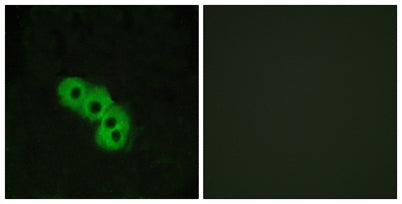
Applications: WB;IF;ELISA
Reactivity: Human;Mouse;Rat
Source: Rabbit
Dilution: Western Blot: 1/500 - 1/2000. Immunofluorescence: 1/200 - 1/1000. ELISA: 1/10000. Not yet tested in other applications.
Immunogen: The antiserum was produced against synthesized peptide derived from human GPR109. AA range:285-334
Storage_stability: -20°C/1 year
Clonality: Polyclonal
Isotype: IgG
Concentration: 1 mg/ml
Observed_band(KD): 45kD
Human_gene_id: 8843/338442
Human_swiss_prot_no: P49019/Q8TDS4
Subcellular_location: Cell membrane; Multi-pass membrane protein.
Other_name: HCAR3; GPR109B; HCA3; HM74B; NIACR2; Hydroxycarboxylic acid receptor 3; G-protein coupled receptor 109B; G-protein coupled receptor HM74; G-protein coupled receptor HM74B; Niacin receptor 2; Nicotinic acid receptor 2; HCAR2; GPR109A; HCA2;
Background: developmental stage:Expression in neutrophils occurs in the late terminal differentiation phase.,function:Acts as a high affinity receptor for both nicotinic acid (also known as niacin) and (D)-beta-hydroxybutyrate and mediates increased adiponectin secretion and decreased lipolysis through G(i)-protein-mediated inhibition of adenylyl cyclase. This pharmacological effect requires nicotinic acid doses that are much higher than those provided by a normal diet. Mediates nicotinic acid-induced apoptosis in mature neutrophils. Receptor activation by nicotinic acid results in reduced cAMP levels which may affect activity of cAMP-dependent protein kinase A and phosphorylation of target proteins, leading to neutrophil apoptosis.,miscellaneous:The rank order of potency for the displacement of nicotinic acid binding is 5-methyl pyrazole-3-carboxylic acid = pyridine-3-acetic acid > acifran > 5-methyl nicotinic acid = acipimox >> nicotinuric acid = nicotinamide.,similarity:Belongs to the G-protein coupled receptor 1 family.,tissue specificity:Expression largely restricted to adipose tissue and spleen. Expressed on mature neutrophils but not on immature neutrophils or eosinophils.,
Reactivity: Human;Mouse;Rat
Source: Rabbit
Dilution: Western Blot: 1/500 - 1/2000. Immunofluorescence: 1/200 - 1/1000. ELISA: 1/10000. Not yet tested in other applications.
Immunogen: The antiserum was produced against synthesized peptide derived from human GPR109. AA range:285-334
Storage_stability: -20°C/1 year
Clonality: Polyclonal
Isotype: IgG
Concentration: 1 mg/ml
Observed_band(KD): 45kD
Human_gene_id: 8843/338442
Human_swiss_prot_no: P49019/Q8TDS4
Subcellular_location: Cell membrane; Multi-pass membrane protein.
Other_name: HCAR3; GPR109B; HCA3; HM74B; NIACR2; Hydroxycarboxylic acid receptor 3; G-protein coupled receptor 109B; G-protein coupled receptor HM74; G-protein coupled receptor HM74B; Niacin receptor 2; Nicotinic acid receptor 2; HCAR2; GPR109A; HCA2;
Background: developmental stage:Expression in neutrophils occurs in the late terminal differentiation phase.,function:Acts as a high affinity receptor for both nicotinic acid (also known as niacin) and (D)-beta-hydroxybutyrate and mediates increased adiponectin secretion and decreased lipolysis through G(i)-protein-mediated inhibition of adenylyl cyclase. This pharmacological effect requires nicotinic acid doses that are much higher than those provided by a normal diet. Mediates nicotinic acid-induced apoptosis in mature neutrophils. Receptor activation by nicotinic acid results in reduced cAMP levels which may affect activity of cAMP-dependent protein kinase A and phosphorylation of target proteins, leading to neutrophil apoptosis.,miscellaneous:The rank order of potency for the displacement of nicotinic acid binding is 5-methyl pyrazole-3-carboxylic acid = pyridine-3-acetic acid > acifran > 5-methyl nicotinic acid = acipimox >> nicotinuric acid = nicotinamide.,similarity:Belongs to the G-protein coupled receptor 1 family.,tissue specificity:Expression largely restricted to adipose tissue and spleen. Expressed on mature neutrophils but not on immature neutrophils or eosinophils.,
Share