1
/
of
1
ELK Biotechnology
SKU:ES7765
PAR-6β rabbit pAb
PAR-6β rabbit pAb
Regular price
$250.00 USD
Regular price
Sale price
$250.00 USD
Unit price
/
per
Shipping calculated at checkout.
Couldn't load pickup availability
Applications: WB;IHC;IF;ELISA
Reactivity: Human;Mouse
Source: Rabbit
Dilution: Western Blot: 1/500 - 1/2000. Immunohistochemistry: 1/100 - 1/300. ELISA: 1/5000. Not yet tested in other applications.
Immunogen: The antiserum was produced against synthesized peptide derived from human PARD6B. AA range:233-282
Storage_stability: -20°C/1 year
Clonality: Polyclonal
Isotype: IgG
Concentration: 1 mg/ml
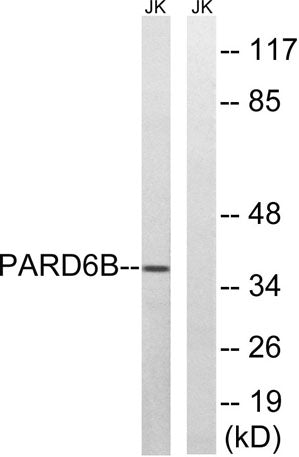
Observed_band(KD): 38kD
Human_gene_id: 84612
Human_swiss_prot_no: Q9BYG5
Subcellular_location: Cytoplasm. Cell membrane . Cell junction, tight junction .
Other_name: PARD6B; PAR6B; Partitioning defective 6 homolog beta; PAR-6 beta; PAR-6B
Background: This gene is a member of the PAR6 family and encodes a protein with a PSD95/Discs-large/ZO1 (PDZ) domain, an OPR domain and a semi-Cdc42/Rac interactive binding (CRIB) domain. This cytoplasmic protein is involved in asymmetrical cell division and cell polarization processes as a member of a multi-protein complex. [provided by RefSeq, Jul 2008],
Reactivity: Human;Mouse
Source: Rabbit
Dilution: Western Blot: 1/500 - 1/2000. Immunohistochemistry: 1/100 - 1/300. ELISA: 1/5000. Not yet tested in other applications.
Immunogen: The antiserum was produced against synthesized peptide derived from human PARD6B. AA range:233-282
Storage_stability: -20°C/1 year
Clonality: Polyclonal
Isotype: IgG
Concentration: 1 mg/ml
Observed_band(KD): 38kD
Human_gene_id: 84612
Human_swiss_prot_no: Q9BYG5
Subcellular_location: Cytoplasm. Cell membrane . Cell junction, tight junction .
Other_name: PARD6B; PAR6B; Partitioning defective 6 homolog beta; PAR-6 beta; PAR-6B
Background: This gene is a member of the PAR6 family and encodes a protein with a PSD95/Discs-large/ZO1 (PDZ) domain, an OPR domain and a semi-Cdc42/Rac interactive binding (CRIB) domain. This cytoplasmic protein is involved in asymmetrical cell division and cell polarization processes as a member of a multi-protein complex. [provided by RefSeq, Jul 2008],
Share