1
/
of
1
ELK Biotechnology
SKU:ES7706
AIP4 (phospho Tyr420) rabbit pAb
AIP4 (phospho Tyr420) rabbit pAb
Regular price
$250.00 USD
Regular price
Sale price
$250.00 USD
Unit price
/
per
Shipping calculated at checkout.
Couldn't load pickup availability
Applications: IHC;IF;ELISA
Reactivity: Human;Mouse
Source: Rabbit
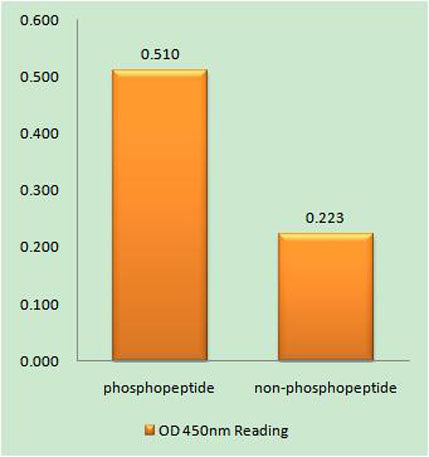
Dilution: Immunohistochemistry: 1/100 - 1/300. ELISA: 1/20000. Not yet tested in other applications.
Immunogen: The antiserum was produced against synthesized peptide derived from human ITCH around the phosphorylation site of Tyr420. AA range:386-435
Storage_stability: -20°C/1 year
Clonality: Polyclonal
Isotype: IgG
Concentration: 1 mg/ml
Human_gene_id: 83737
Human_swiss_prot_no: Q96J02
Subcellular_location: Cell membrane ; Peripheral membrane protein ; Cytoplasmic side . Cytoplasm . Nucleus . Early endosome membrane ; Peripheral membrane protein ; Cytoplasmic side . Endosome membrane ; Peripheral membrane protein ; Cytoplasmic side . May be recruited to exosomes by NDFIP1 (PubMed:18819914). Localizes to plasma membrane upon CXCL12 stimulation where it co-localizes with CXCL4 (PubMed:14602072). Localization to early endosomes is increased upon CXCL12 stimulation where it co-localizes with DTX3L and CXCL4 (PubMed:24790097). .
Other_name: ITCH; E3 ubiquitin-protein ligase Itchy homolog; Itch; Atrophin-1-interacting protein 4; AIP4; NFE2-associated polypeptide 1; NAPP1
Background: itchy E3 ubiquitin protein ligase(ITCH) Homo sapiens This gene encodes a member of the Nedd4 family of HECT domain E3 ubiquitin ligases. HECT domain E3 ubiquitin ligases transfer ubiquitin from E2 ubiquitin-conjugating enzymes to protein substrates, thus targeting specific proteins for lysosomal degradation. The encoded protein plays a role in multiple cellular processes including erythroid and lymphoid cell differentiation and the regulation of immune responses. Mutations in this gene are a cause of syndromic multisystem autoimmune disease. Alternatively spliced transcript variants encoding multiple isoforms have been observed for this gene. [provided by RefSeq, Mar 2012],
Reactivity: Human;Mouse
Source: Rabbit
Dilution: Immunohistochemistry: 1/100 - 1/300. ELISA: 1/20000. Not yet tested in other applications.
Immunogen: The antiserum was produced against synthesized peptide derived from human ITCH around the phosphorylation site of Tyr420. AA range:386-435
Storage_stability: -20°C/1 year
Clonality: Polyclonal
Isotype: IgG
Concentration: 1 mg/ml
Human_gene_id: 83737
Human_swiss_prot_no: Q96J02
Subcellular_location: Cell membrane ; Peripheral membrane protein ; Cytoplasmic side . Cytoplasm . Nucleus . Early endosome membrane ; Peripheral membrane protein ; Cytoplasmic side . Endosome membrane ; Peripheral membrane protein ; Cytoplasmic side . May be recruited to exosomes by NDFIP1 (PubMed:18819914). Localizes to plasma membrane upon CXCL12 stimulation where it co-localizes with CXCL4 (PubMed:14602072). Localization to early endosomes is increased upon CXCL12 stimulation where it co-localizes with DTX3L and CXCL4 (PubMed:24790097). .
Other_name: ITCH; E3 ubiquitin-protein ligase Itchy homolog; Itch; Atrophin-1-interacting protein 4; AIP4; NFE2-associated polypeptide 1; NAPP1
Background: itchy E3 ubiquitin protein ligase(ITCH) Homo sapiens This gene encodes a member of the Nedd4 family of HECT domain E3 ubiquitin ligases. HECT domain E3 ubiquitin ligases transfer ubiquitin from E2 ubiquitin-conjugating enzymes to protein substrates, thus targeting specific proteins for lysosomal degradation. The encoded protein plays a role in multiple cellular processes including erythroid and lymphoid cell differentiation and the regulation of immune responses. Mutations in this gene are a cause of syndromic multisystem autoimmune disease. Alternatively spliced transcript variants encoding multiple isoforms have been observed for this gene. [provided by RefSeq, Mar 2012],
Share