1
/
of
1
ELK Biotechnology
SKU:ES6865
PSMC3 rabbit pAb
PSMC3 rabbit pAb
Regular price
$250.00 USD
Regular price
Sale price
$250.00 USD
Unit price
/
per
Shipping calculated at checkout.
Couldn't load pickup availability
Applications: WB;IHC;IF;ELISA
Reactivity: Human;Mouse;Rat
Source: Rabbit
Dilution: Western Blot: 1/500 - 1/2000. Immunohistochemistry: 1/100 - 1/300. ELISA: 1/40000. Not yet tested in other applications.
Immunogen: The antiserum was produced against synthesized peptide derived from human PRS6A. AA range:271-320
Storage_stability: -20°C/1 year
Clonality: Polyclonal
Isotype: IgG
Concentration: 1 mg/ml
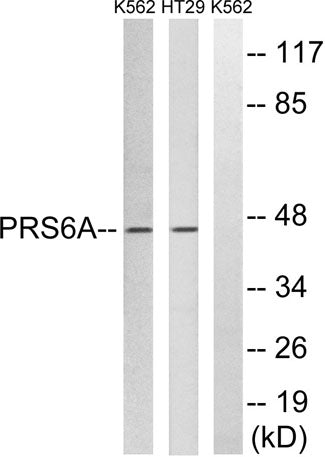
Observed_band(KD): 45kD
Human_gene_id: 5702
Human_swiss_prot_no: P17980
Subcellular_location: Cytoplasm . Nucleus . Colocalizes with TRIM5 in the cytoplasmic bodies. .
Other_name: PSMC3; TBP1; 26S protease regulatory subunit 6A; 26S proteasome AAA-ATPase subunit RPT5; Proteasome 26S subunit ATPase 3; Proteasome subunit P50; Tat-binding protein 1; TBP-1
Background: proteasome 26S subunit, ATPase 3(PSMC3) Homo sapiens The 26S proteasome is a multicatalytic proteinase complex with a highly ordered structure composed of 2 complexes, a 20S core and a 19S regulator. The 20S core is composed of 4 rings of 28 non-identical subunits; 2 rings are composed of 7 alpha subunits and 2 rings are composed of 7 beta subunits. The 19S regulator is composed of a base, which contains 6 ATPase subunits and 2 non-ATPase subunits, and a lid, which contains up to 10 non-ATPase subunits. Proteasomes are distributed throughout eukaryotic cells at a high concentration and cleave peptides in an ATP/ubiquitin-dependent process in a non-lysosomal pathway. An essential function of a modified proteasome, the immunoproteasome, is the processing of class I MHC peptides. This gene encodes one of the ATPase subunits, a member of the triple-A family of ATPases that have chaperone-like activity. This subunit may compete with PSMC2 for bindi
Reactivity: Human;Mouse;Rat
Source: Rabbit
Dilution: Western Blot: 1/500 - 1/2000. Immunohistochemistry: 1/100 - 1/300. ELISA: 1/40000. Not yet tested in other applications.
Immunogen: The antiserum was produced against synthesized peptide derived from human PRS6A. AA range:271-320
Storage_stability: -20°C/1 year
Clonality: Polyclonal
Isotype: IgG
Concentration: 1 mg/ml
Observed_band(KD): 45kD
Human_gene_id: 5702
Human_swiss_prot_no: P17980
Subcellular_location: Cytoplasm . Nucleus . Colocalizes with TRIM5 in the cytoplasmic bodies. .
Other_name: PSMC3; TBP1; 26S protease regulatory subunit 6A; 26S proteasome AAA-ATPase subunit RPT5; Proteasome 26S subunit ATPase 3; Proteasome subunit P50; Tat-binding protein 1; TBP-1
Background: proteasome 26S subunit, ATPase 3(PSMC3) Homo sapiens The 26S proteasome is a multicatalytic proteinase complex with a highly ordered structure composed of 2 complexes, a 20S core and a 19S regulator. The 20S core is composed of 4 rings of 28 non-identical subunits; 2 rings are composed of 7 alpha subunits and 2 rings are composed of 7 beta subunits. The 19S regulator is composed of a base, which contains 6 ATPase subunits and 2 non-ATPase subunits, and a lid, which contains up to 10 non-ATPase subunits. Proteasomes are distributed throughout eukaryotic cells at a high concentration and cleave peptides in an ATP/ubiquitin-dependent process in a non-lysosomal pathway. An essential function of a modified proteasome, the immunoproteasome, is the processing of class I MHC peptides. This gene encodes one of the ATPase subunits, a member of the triple-A family of ATPases that have chaperone-like activity. This subunit may compete with PSMC2 for bindi
Share