1
/
of
1
ELK Biotechnology
SKU:ES6740
PKAα/β/γ cat (phospho Thr197) rabbit pAb
PKAα/β/γ cat (phospho Thr197) rabbit pAb
Regular price
$250.00 USD
Regular price
Sale price
$250.00 USD
Unit price
/
per
Shipping calculated at checkout.
Couldn't load pickup availability
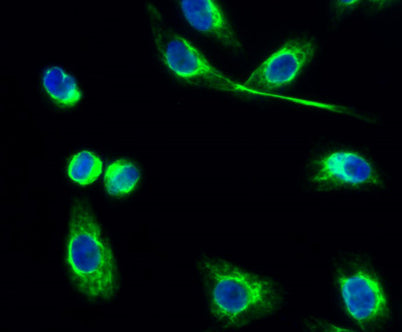
Applications: WB;IHC;IF;ELISA
Reactivity: Human;Mouse;Rat
Source: Rabbit
Dilution: Western Blot: 1/500 - 1/2000. Immunohistochemistry: 1/100 - 1/300. Immunofluorescence: 1/200 - 1/1000. ELISA: 1/10000. Not yet tested in other applications.
Immunogen: The antiserum was produced against synthesized peptide derived from human PKA CAT around the phosphorylation site of Thr197. AA range:166-215
Storage_stability: -20°C/1 year
Clonality: Polyclonal
Isotype: IgG
Concentration: 1 mg/ml
Observed_band(KD): 40kD
Human_gene_id: 5566/5567
Human_swiss_prot_no: P17612/P22694/P22612
Subcellular_location: Cytoplasm. Cell membrane. Nucleus . Mitochondrion . Membrane ; Lipid-anchor . Translocates into the nucleus (monomeric catalytic subunit). The inactive holoenzyme is found in the cytoplasm. Distributed throughout the cytoplasm in meiotically incompetent oocytes. Associated to mitochondrion as meiotic competence is acquired. Aggregates around the germinal vesicles (GV) at the immature GV stage oocytes (By similarity). Colocalizes with HSF1 in nuclear stress bodies (nSBs) upon heat shock (PubMed:21085490). .; [Isoform 2]: Cell projection, cilium, flagellum . Cytoplasmic vesicle, secretory vesicle, acrosome . Expressed in the midpiece region of the sperm flagellum (PubMed:10906071). Colocalizes with MROH2B and TCP11 on the acrosome and tail regions in round spermatids and spermatozoa regardle
Other_name: PRKACA; PKACA; cAMP-dependent protein kinase catalytic subunit alpha; PKA C-alpha; PRKACB; cAMP-dependent protein kinase catalytic subunit beta; PKA C-beta; PRKACG; cAMP-dependent protein kinase catalytic subunit gamma; PKA C-gamma
Background: This gene encodes one of the catalytic subunits of protein kinase A, which exists as a tetrameric holoenzyme with two regulatory subunits and two catalytic subunits, in its inactive form. cAMP causes the dissociation of the inactive holoenzyme into a dimer of regulatory subunits bound to four cAMP and two free monomeric catalytic subunits. Four different regulatory subunits and three catalytic subunits have been identified in humans. cAMP-dependent phosphorylation of proteins by protein kinase A is important to many cellular processes, including differentiation, proliferation, and apoptosis. Constitutive activation of this gene caused either by somatic mutations, or genomic duplications of regions that include this gene, have been associated with hyperplasias and adenomas of the adrenal cortex and are linked to corticotropin-independent Cushing's syndrome. Altern
Reactivity: Human;Mouse;Rat
Source: Rabbit
Dilution: Western Blot: 1/500 - 1/2000. Immunohistochemistry: 1/100 - 1/300. Immunofluorescence: 1/200 - 1/1000. ELISA: 1/10000. Not yet tested in other applications.
Immunogen: The antiserum was produced against synthesized peptide derived from human PKA CAT around the phosphorylation site of Thr197. AA range:166-215
Storage_stability: -20°C/1 year
Clonality: Polyclonal
Isotype: IgG
Concentration: 1 mg/ml
Observed_band(KD): 40kD
Human_gene_id: 5566/5567
Human_swiss_prot_no: P17612/P22694/P22612
Subcellular_location: Cytoplasm. Cell membrane. Nucleus . Mitochondrion . Membrane ; Lipid-anchor . Translocates into the nucleus (monomeric catalytic subunit). The inactive holoenzyme is found in the cytoplasm. Distributed throughout the cytoplasm in meiotically incompetent oocytes. Associated to mitochondrion as meiotic competence is acquired. Aggregates around the germinal vesicles (GV) at the immature GV stage oocytes (By similarity). Colocalizes with HSF1 in nuclear stress bodies (nSBs) upon heat shock (PubMed:21085490). .; [Isoform 2]: Cell projection, cilium, flagellum . Cytoplasmic vesicle, secretory vesicle, acrosome . Expressed in the midpiece region of the sperm flagellum (PubMed:10906071). Colocalizes with MROH2B and TCP11 on the acrosome and tail regions in round spermatids and spermatozoa regardle
Other_name: PRKACA; PKACA; cAMP-dependent protein kinase catalytic subunit alpha; PKA C-alpha; PRKACB; cAMP-dependent protein kinase catalytic subunit beta; PKA C-beta; PRKACG; cAMP-dependent protein kinase catalytic subunit gamma; PKA C-gamma
Background: This gene encodes one of the catalytic subunits of protein kinase A, which exists as a tetrameric holoenzyme with two regulatory subunits and two catalytic subunits, in its inactive form. cAMP causes the dissociation of the inactive holoenzyme into a dimer of regulatory subunits bound to four cAMP and two free monomeric catalytic subunits. Four different regulatory subunits and three catalytic subunits have been identified in humans. cAMP-dependent phosphorylation of proteins by protein kinase A is important to many cellular processes, including differentiation, proliferation, and apoptosis. Constitutive activation of this gene caused either by somatic mutations, or genomic duplications of regions that include this gene, have been associated with hyperplasias and adenomas of the adrenal cortex and are linked to corticotropin-independent Cushing's syndrome. Altern
Share