1
/
of
1
ELK Biotechnology
SKU:ES6670
TRAP220 (phospho Thr1457) rabbit pAb
TRAP220 (phospho Thr1457) rabbit pAb
Regular price
$250.00 USD
Regular price
Sale price
$250.00 USD
Unit price
/
per
Shipping calculated at checkout.
Couldn't load pickup availability
Applications: WB;IHC;IF;ELISA
Reactivity: Human;Mouse;Monkey
Source: Rabbit
Dilution: Western Blot: 1/500 - 1/2000. Immunohistochemistry: 1/100 - 1/300. Immunofluorescence: 1/200 - 1/1000. ELISA: 1/5000. Not yet tested in other applications.
Immunogen: The antiserum was produced against synthesized peptide derived from human PPAR-BP around the phosphorylation site of Thr1457. AA range:1423-1472
Storage_stability: -20°C/1 year
Clonality: Polyclonal
Isotype: IgG
Concentration: 1 mg/ml
Observed_band(KD): 168kD
Human_gene_id: 5469
Human_swiss_prot_no: Q15648
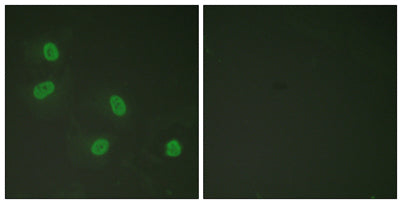
Subcellular_location: Nucleus . A subset of the protein may enter the nucleolus subsequent to phosphorylation by MAPK1 or MAPK3.
Other_name: MED1; ARC205; CRSP1; CRSP200; DRIP205; DRIP230; PBP; PPARBP; PPARGBP; RB18A; TRAP220; TRIP2; Mediator of RNA polymerase II transcription subunit 1; Activator-recruited cofactor 205 kDa component; ARC205; Mediator complex subunit 1; Peroxiso
Background: The activation of gene transcription is a multistep process that is triggered by factors that recognize transcriptional enhancer sites in DNA. These factors work with co-activators to direct transcriptional initiation by the RNA polymerase II apparatus. The protein encoded by this gene is a subunit of the CRSP (cofactor required for SP1 activation) complex, which, along with TFIID, is required for efficient activation by SP1. This protein is also a component of other multisubunit complexes e.g. thyroid hormone receptor-(TR-) associated proteins which interact with TR and facilitate TR function on DNA templates in conjunction with initiation factors and cofactors. It also regulates p53-dependent apoptosis and it is essential for adipogenesis. This protein is known to have the ability to self-oligomerize. [provided by RefSeq, Jul 2008],
Reactivity: Human;Mouse;Monkey
Source: Rabbit
Dilution: Western Blot: 1/500 - 1/2000. Immunohistochemistry: 1/100 - 1/300. Immunofluorescence: 1/200 - 1/1000. ELISA: 1/5000. Not yet tested in other applications.
Immunogen: The antiserum was produced against synthesized peptide derived from human PPAR-BP around the phosphorylation site of Thr1457. AA range:1423-1472
Storage_stability: -20°C/1 year
Clonality: Polyclonal
Isotype: IgG
Concentration: 1 mg/ml
Observed_band(KD): 168kD
Human_gene_id: 5469
Human_swiss_prot_no: Q15648
Subcellular_location: Nucleus . A subset of the protein may enter the nucleolus subsequent to phosphorylation by MAPK1 or MAPK3.
Other_name: MED1; ARC205; CRSP1; CRSP200; DRIP205; DRIP230; PBP; PPARBP; PPARGBP; RB18A; TRAP220; TRIP2; Mediator of RNA polymerase II transcription subunit 1; Activator-recruited cofactor 205 kDa component; ARC205; Mediator complex subunit 1; Peroxiso
Background: The activation of gene transcription is a multistep process that is triggered by factors that recognize transcriptional enhancer sites in DNA. These factors work with co-activators to direct transcriptional initiation by the RNA polymerase II apparatus. The protein encoded by this gene is a subunit of the CRSP (cofactor required for SP1 activation) complex, which, along with TFIID, is required for efficient activation by SP1. This protein is also a component of other multisubunit complexes e.g. thyroid hormone receptor-(TR-) associated proteins which interact with TR and facilitate TR function on DNA templates in conjunction with initiation factors and cofactors. It also regulates p53-dependent apoptosis and it is essential for adipogenesis. This protein is known to have the ability to self-oligomerize. [provided by RefSeq, Jul 2008],
Share