1
/
of
1
ELK Biotechnology
SKU:ES6626
ATP7A rabbit pAb
ATP7A rabbit pAb
Regular price
$250.00 USD
Regular price
Sale price
$250.00 USD
Unit price
/
per
Shipping calculated at checkout.
Couldn't load pickup availability
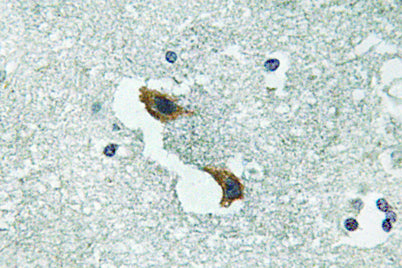
Applications: IHC;IF;ELISA
Reactivity: Human;Mouse;Rat
Source: Rabbit
Dilution: Immunohistochemistry: 1/100 - 1/300. ELISA: 1/40000. Not yet tested in other applications.
Immunogen: The antiserum was produced against synthesized peptide derived from human ATP7A. AA range:591-640
Storage_stability: -20°C/1 year
Clonality: Polyclonal
Isotype: IgG
Concentration: 1 mg/ml
Human_gene_id: 538
Human_swiss_prot_no: Q04656
Subcellular_location: Golgi apparatus, trans-Golgi network membrane ; Multi-pass membrane protein . Cell membrane ; Multi-pass membrane protein . Melanosome membrane ; Multi-pass membrane protein . Early endosome membrane ; Multi-pass membrane protein . Cell projection, axon . Cell projection, dendrite . Cell junction, synapse, postsynaptic density . Cycles constitutively between the TGN and the plasma membrane (PubMed:9147644). Predominantly found in the TGN and relocalized to the plasma membrane in response to elevated copper levels. Targeting into melanosomes is regulated by BLOC-1 complex (By similarity). In response to glutamate, translocates to neuron processes with a minor fraction at extrasynaptic sites (By similarity). .; [Isoform 3]: Cytoplasm, cytosol .; [Isoform 5]: Endoplasmic reticulum .
Other_name: ATP7A; MC1; MNK; Copper-transporting ATPase 1; Copper pump 1; Menkes disease-associated protein
Background: ATPase copper transporting alpha(ATP7A) Homo sapiens This gene encodes a transmembrane protein that functions in copper transport across membranes. This protein is localized to the trans Golgi network, where it is predicted to supply copper to copper-dependent enzymes in the secretory pathway. It relocalizes to the plasma membrane under conditions of elevated extracellular copper, and functions in the efflux of copper from cells. Mutations in this gene are associated with Menkes disease, X-linked distal spinal muscular atrophy, and occipital horn syndrome. Alternatively-spliced transcript variants have been observed. [provided by RefSeq, Aug 2013],
Reactivity: Human;Mouse;Rat
Source: Rabbit
Dilution: Immunohistochemistry: 1/100 - 1/300. ELISA: 1/40000. Not yet tested in other applications.
Immunogen: The antiserum was produced against synthesized peptide derived from human ATP7A. AA range:591-640
Storage_stability: -20°C/1 year
Clonality: Polyclonal
Isotype: IgG
Concentration: 1 mg/ml
Human_gene_id: 538
Human_swiss_prot_no: Q04656
Subcellular_location: Golgi apparatus, trans-Golgi network membrane ; Multi-pass membrane protein . Cell membrane ; Multi-pass membrane protein . Melanosome membrane ; Multi-pass membrane protein . Early endosome membrane ; Multi-pass membrane protein . Cell projection, axon . Cell projection, dendrite . Cell junction, synapse, postsynaptic density . Cycles constitutively between the TGN and the plasma membrane (PubMed:9147644). Predominantly found in the TGN and relocalized to the plasma membrane in response to elevated copper levels. Targeting into melanosomes is regulated by BLOC-1 complex (By similarity). In response to glutamate, translocates to neuron processes with a minor fraction at extrasynaptic sites (By similarity). .; [Isoform 3]: Cytoplasm, cytosol .; [Isoform 5]: Endoplasmic reticulum .
Other_name: ATP7A; MC1; MNK; Copper-transporting ATPase 1; Copper pump 1; Menkes disease-associated protein
Background: ATPase copper transporting alpha(ATP7A) Homo sapiens This gene encodes a transmembrane protein that functions in copper transport across membranes. This protein is localized to the trans Golgi network, where it is predicted to supply copper to copper-dependent enzymes in the secretory pathway. It relocalizes to the plasma membrane under conditions of elevated extracellular copper, and functions in the efflux of copper from cells. Mutations in this gene are associated with Menkes disease, X-linked distal spinal muscular atrophy, and occipital horn syndrome. Alternatively-spliced transcript variants have been observed. [provided by RefSeq, Aug 2013],
Share