1
/
of
1
ELK Biotechnology
SKU:ES5906
SHIP-1 rabbit pAb
SHIP-1 rabbit pAb
Regular price
$250.00 USD
Regular price
Sale price
$250.00 USD
Unit price
/
per
Shipping calculated at checkout.
Couldn't load pickup availability
Applications: WB;ELISA;IHC
Reactivity: Human;Mouse;Rat
Source: Rabbit
Dilution: WB 1:500-2000;IHC-p 1:50-300; ELISA 2000-20000
Immunogen: The antiserum was produced against synthesized peptide derived from human SHIP1. AA range:987-1036
Storage_stability: -20°C/1 year
Clonality: Polyclonal
Isotype: IgG
Concentration: 1 mg/ml
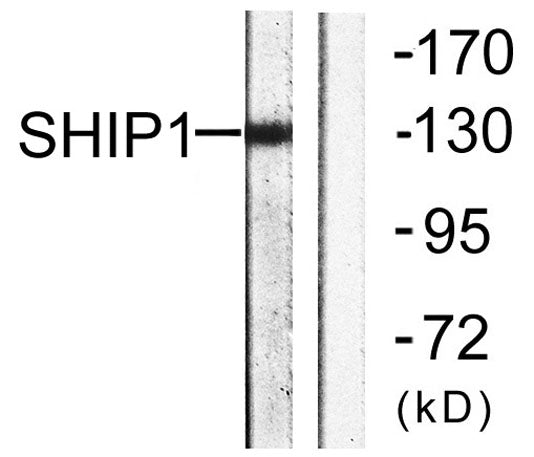
Observed_band(KD): 133kD
Human_gene_id: 3635
Human_swiss_prot_no: Q92835
Subcellular_location: Cytoplasm . Cell membrane ; Peripheral membrane protein . Membrane raft . Cytoplasm, cytoskeleton . Membrane ; Peripheral membrane protein . Translocates to the plasma membrane when activated, translocation is probably due to different mechanisms depending on the stimulus and cell type. Translocates from the cytoplasm to membrane ruffles in a FCGR3/CD16-dependent manner. Colocalizes with FC-gamma-RIIB receptor (FCGR2B) or FCGR3/CD16 at membrane ruffles. Tyrosine phosphorylation may also participate in membrane localization. .
Other_name: INPP5D; SHIP; SHIP1; Phosphatidylinositol 3; 4,5-trisphosphate 5-phosphatase 1; Inositol polyphosphate-5-phosphatase of 145 kDa; SIP-145; SH2 domain-containing inositol 5'-phosphatase 1; SH2 domain-containing inositol phosphatase 1; SHIP-1;
Background: This gene is a member of the inositol polyphosphate-5-phosphatase (INPP5) family and encodes a protein with an N-terminal SH2 domain, an inositol phosphatase domain, and two C-terminal protein interaction domains. Expression of this protein is restricted to hematopoietic cells where its movement from the cytosol to the plasma membrane is mediated by tyrosine phosphorylation. At the plasma membrane, the protein hydrolyzes the 5' phosphate from phosphatidylinositol (3,4,5)-trisphosphate and inositol-1,3,4,5-tetrakisphosphate, thereby affecting multiple signaling pathways. The protein is also partly localized to the nucleus, where it may be involved in nuclear inositol phosphate signaling processes. Overall, the protein functions as a negative regulator of myeloid cell proliferation and survival. Mutations in this gene are associated with defects and cancers of the immune system. A
Reactivity: Human;Mouse;Rat
Source: Rabbit
Dilution: WB 1:500-2000;IHC-p 1:50-300; ELISA 2000-20000
Immunogen: The antiserum was produced against synthesized peptide derived from human SHIP1. AA range:987-1036
Storage_stability: -20°C/1 year
Clonality: Polyclonal
Isotype: IgG
Concentration: 1 mg/ml
Observed_band(KD): 133kD
Human_gene_id: 3635
Human_swiss_prot_no: Q92835
Subcellular_location: Cytoplasm . Cell membrane ; Peripheral membrane protein . Membrane raft . Cytoplasm, cytoskeleton . Membrane ; Peripheral membrane protein . Translocates to the plasma membrane when activated, translocation is probably due to different mechanisms depending on the stimulus and cell type. Translocates from the cytoplasm to membrane ruffles in a FCGR3/CD16-dependent manner. Colocalizes with FC-gamma-RIIB receptor (FCGR2B) or FCGR3/CD16 at membrane ruffles. Tyrosine phosphorylation may also participate in membrane localization. .
Other_name: INPP5D; SHIP; SHIP1; Phosphatidylinositol 3; 4,5-trisphosphate 5-phosphatase 1; Inositol polyphosphate-5-phosphatase of 145 kDa; SIP-145; SH2 domain-containing inositol 5'-phosphatase 1; SH2 domain-containing inositol phosphatase 1; SHIP-1;
Background: This gene is a member of the inositol polyphosphate-5-phosphatase (INPP5) family and encodes a protein with an N-terminal SH2 domain, an inositol phosphatase domain, and two C-terminal protein interaction domains. Expression of this protein is restricted to hematopoietic cells where its movement from the cytosol to the plasma membrane is mediated by tyrosine phosphorylation. At the plasma membrane, the protein hydrolyzes the 5' phosphate from phosphatidylinositol (3,4,5)-trisphosphate and inositol-1,3,4,5-tetrakisphosphate, thereby affecting multiple signaling pathways. The protein is also partly localized to the nucleus, where it may be involved in nuclear inositol phosphate signaling processes. Overall, the protein functions as a negative regulator of myeloid cell proliferation and survival. Mutations in this gene are associated with defects and cancers of the immune system. A
Share