1
/
of
1
ELK Biotechnology
SKU:ES5790
Survivin Rabbit pAb(N-ternal)
Survivin Rabbit pAb(N-ternal)
Regular price
$250.00 USD
Regular price
Sale price
$250.00 USD
Unit price
/
per
Shipping calculated at checkout.
Couldn't load pickup availability
Applications: WB;IHC;IF;ELISA
Reactivity: Human;Mouse;Rat
Source: Rabbit
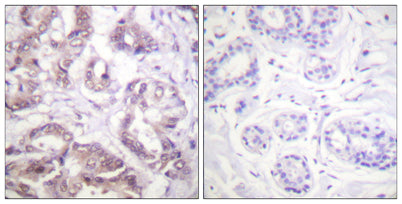
Dilution: Immunohistochemistry: 1/100 - 1/300. ELISA: 1/5000. Not yet tested in other applications.
Immunogen: The antiserum was produced against synthesized peptide derived from human Survivin. AA range:11-60
Storage_stability: -20°C/1 year
Clonality: Polyclonal
Isotype: IgG
Concentration: 1 mg/ml
Human_gene_id: 332
Human_swiss_prot_no: O15392
Subcellular_location: Cytoplasm . Nucleus . Chromosome . Chromosome, centromere . Cytoplasm, cytoskeleton, spindle . Chromosome, centromere, kinetochore . Midbody . Localizes at the centromeres from prophase to metaphase, at the spindle midzone during anaphase and a the midbody during telophase and cytokinesis. Accumulates in the nucleus upon treatment with leptomycin B (LMB), a XPO1/CRM1 nuclear export inhibitor (By similarity). Localizes on chromosome arms and inner centromeres from prophase through metaphase. Localizes to kinetochores in metaphase, distributes to the midzone microtubules in anaphase and at telophase, localizes exclusively to the midbody (PubMed:11084331). Colocalizes with AURKB at mitotic chromosomes (PubMed:14610074). Acetylation at Lys-129 directs its localization to the nucleus by enhanci
Other_name: BIRC5; API4; IAP4; Baculoviral IAP repeat-containing protein 5; Apoptosis inhibitor 4; Apoptosis inhibitor survivin
Background: This gene is a member of the inhibitor of apoptosis (IAP) gene family, which encode negative regulatory proteins that prevent apoptotic cell death. IAP family members usually contain multiple baculovirus IAP repeat (BIR) domains, but this gene encodes proteins with only a single BIR domain. The encoded proteins also lack a C-terminus RING finger domain. Gene expression is high during fetal development and in most tumors, yet low in adult tissues. Alternatively spliced transcript variants encoding distinct isoforms have been found for this gene. [provided by RefSeq, Jun 2011],
Reactivity: Human;Mouse;Rat
Source: Rabbit
Dilution: Immunohistochemistry: 1/100 - 1/300. ELISA: 1/5000. Not yet tested in other applications.
Immunogen: The antiserum was produced against synthesized peptide derived from human Survivin. AA range:11-60
Storage_stability: -20°C/1 year
Clonality: Polyclonal
Isotype: IgG
Concentration: 1 mg/ml
Human_gene_id: 332
Human_swiss_prot_no: O15392
Subcellular_location: Cytoplasm . Nucleus . Chromosome . Chromosome, centromere . Cytoplasm, cytoskeleton, spindle . Chromosome, centromere, kinetochore . Midbody . Localizes at the centromeres from prophase to metaphase, at the spindle midzone during anaphase and a the midbody during telophase and cytokinesis. Accumulates in the nucleus upon treatment with leptomycin B (LMB), a XPO1/CRM1 nuclear export inhibitor (By similarity). Localizes on chromosome arms and inner centromeres from prophase through metaphase. Localizes to kinetochores in metaphase, distributes to the midzone microtubules in anaphase and at telophase, localizes exclusively to the midbody (PubMed:11084331). Colocalizes with AURKB at mitotic chromosomes (PubMed:14610074). Acetylation at Lys-129 directs its localization to the nucleus by enhanci
Other_name: BIRC5; API4; IAP4; Baculoviral IAP repeat-containing protein 5; Apoptosis inhibitor 4; Apoptosis inhibitor survivin
Background: This gene is a member of the inhibitor of apoptosis (IAP) gene family, which encode negative regulatory proteins that prevent apoptotic cell death. IAP family members usually contain multiple baculovirus IAP repeat (BIR) domains, but this gene encodes proteins with only a single BIR domain. The encoded proteins also lack a C-terminus RING finger domain. Gene expression is high during fetal development and in most tumors, yet low in adult tissues. Alternatively spliced transcript variants encoding distinct isoforms have been found for this gene. [provided by RefSeq, Jun 2011],
Share