1
/
of
1
ELK Biotechnology
SKU:ES5653
NMDAε1/2 rabbit pAb
NMDAε1/2 rabbit pAb
Regular price
$250.00 USD
Regular price
Sale price
$250.00 USD
Unit price
/
per
Shipping calculated at checkout.
Couldn't load pickup availability
Applications: IHC;IF;ELISA
Reactivity: Human;Mouse;Rat
Source: Rabbit
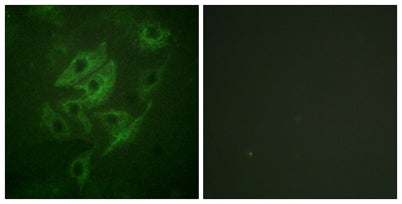
Dilution: Immunohistochemistry: 1/100 - 1/300. Immunofluorescence: 1/200 - 1/1000. ELISA: 1/20000. Not yet tested in other applications.
Immunogen: The antiserum was produced against synthesized peptide derived from human NMDAR2A/B. AA range:1216-1265
Storage_stability: -20°C/1 year
Clonality: Polyclonal
Isotype: IgG
Concentration: 1 mg/ml
Human_gene_id: 2903/2904
Human_swiss_prot_no: Q12879/Q13224
Subcellular_location: Cell projection, dendritic spine . Cell membrane ; Multi-pass membrane protein . Cell junction, synapse . Cell junction, synapse, postsynaptic cell membrane ; Multi-pass membrane protein . Cytoplasmic vesicle membrane . Expression at the dendrite cell membrane and at synapses is regulated by SORCS2 and the retromer complex. .
Other_name: GRIN2A; NMDAR2A; Glutamate [NMDA] receptor subunit epsilon-1; N-methyl D-aspartate receptor subtype 2A; NMDAR2A; NR2A; hNR2A; GRIN2B; NMDAR2B; Glutamate [NMDA] receptor subunit epsilon-2; N-methyl D-aspartate receptor subtype 2B; NMDAR2B; N
Background: This gene encodes a member of the glutamate-gated ion channel protein family. The encoded protein is an N-methyl-D-aspartate (NMDA) receptor subunit. NMDA receptors are both ligand-gated and voltage-dependent, and are involved in long-term potentiation, an activity-dependent increase in the efficiency of synaptic transmission thought to underlie certain kinds of memory and learning. These receptors are permeable to calcium ions, and activation results in a calcium influx into post-synaptic cells, which results in the activation of several signaling cascades. Disruption of this gene is associated with focal epilepsy and speech disorder with or without mental retardation. Alternative splicing results in multiple transcript variants. [provided by RefSeq, May 2014],
Reactivity: Human;Mouse;Rat
Source: Rabbit
Dilution: Immunohistochemistry: 1/100 - 1/300. Immunofluorescence: 1/200 - 1/1000. ELISA: 1/20000. Not yet tested in other applications.
Immunogen: The antiserum was produced against synthesized peptide derived from human NMDAR2A/B. AA range:1216-1265
Storage_stability: -20°C/1 year
Clonality: Polyclonal
Isotype: IgG
Concentration: 1 mg/ml
Human_gene_id: 2903/2904
Human_swiss_prot_no: Q12879/Q13224
Subcellular_location: Cell projection, dendritic spine . Cell membrane ; Multi-pass membrane protein . Cell junction, synapse . Cell junction, synapse, postsynaptic cell membrane ; Multi-pass membrane protein . Cytoplasmic vesicle membrane . Expression at the dendrite cell membrane and at synapses is regulated by SORCS2 and the retromer complex. .
Other_name: GRIN2A; NMDAR2A; Glutamate [NMDA] receptor subunit epsilon-1; N-methyl D-aspartate receptor subtype 2A; NMDAR2A; NR2A; hNR2A; GRIN2B; NMDAR2B; Glutamate [NMDA] receptor subunit epsilon-2; N-methyl D-aspartate receptor subtype 2B; NMDAR2B; N
Background: This gene encodes a member of the glutamate-gated ion channel protein family. The encoded protein is an N-methyl-D-aspartate (NMDA) receptor subunit. NMDA receptors are both ligand-gated and voltage-dependent, and are involved in long-term potentiation, an activity-dependent increase in the efficiency of synaptic transmission thought to underlie certain kinds of memory and learning. These receptors are permeable to calcium ions, and activation results in a calcium influx into post-synaptic cells, which results in the activation of several signaling cascades. Disruption of this gene is associated with focal epilepsy and speech disorder with or without mental retardation. Alternative splicing results in multiple transcript variants. [provided by RefSeq, May 2014],
Share