1
/
of
1
ELK Biotechnology
SKU:ES5204
Seprase rabbit pAb
Seprase rabbit pAb
Regular price
$250.00 USD
Regular price
Sale price
$250.00 USD
Unit price
/
per
Shipping calculated at checkout.
Couldn't load pickup availability
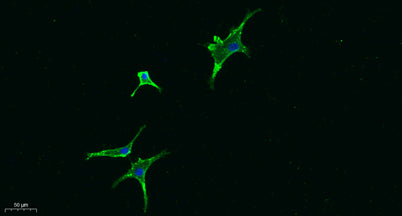
Applications: WB;IHC;IF;ELISA
Reactivity: Human;Mouse;Rat
Source: Rabbit
Dilution: Western Blot: 1/500 - 1/2000. IHC-p: 1:100-300 ELISA: 1/20000. IF 1:100-300 Not yet tested in other applications.
Immunogen: The antiserum was produced against synthesized peptide derived from human FAP-1. AA range:331-380
Storage_stability: -20°C/1 year
Clonality: Polyclonal
Isotype: IgG
Concentration: 1 mg/ml
Observed_band(KD): 90kD
Human_gene_id: 2191
Human_swiss_prot_no: Q12884
Subcellular_location: [Prolyl endopeptidase FAP]: Cell surface . Cell membrane ; Single-pass type II membrane protein . Cell projection, lamellipodium membrane ; Single-pass type II membrane protein . Cell projection, invadopodium membrane ; Single-pass type II membrane protein . Cell projection, ruffle membrane ; Single-pass type II membrane protein . Membrane ; Single-pass type II membrane protein . Localized on cell surface with lamellipodia and invadopodia membranes and on shed vesicles. Colocalized with DPP4 at invadopodia and lamellipodia membranes of migratory activated endothelial cells in collagenous matrix. Colocalized with DPP4 on endothelial cells of capillary-like microvessels but not large vessels within invasive breast ductal carcinoma. Anchored and enriched preferentially by integrin alpha-3/bet
Other_name: FAP; Seprase; 170 kDa melanoma membrane-bound gelatinase; Fibroblast activation protein alpha; Integral membrane serine protease
Background: The protein encoded by this gene is a homodimeric integral membrane gelatinase belonging to the serine protease family. It is selectively expressed in reactive stromal fibroblasts of epithelial cancers, granulation tissue of healing wounds, and malignant cells of bone and soft tissue sarcomas. This protein is thought to be involved in the control of fibroblast growth or epithelial-mesenchymal interactions during development, tissue repair, and epithelial carcinogenesis. Alternatively spliced transcript variants encoding different isoforms have been found for this gene. [provided by RefSeq, Apr 2014],
Reactivity: Human;Mouse;Rat
Source: Rabbit
Dilution: Western Blot: 1/500 - 1/2000. IHC-p: 1:100-300 ELISA: 1/20000. IF 1:100-300 Not yet tested in other applications.
Immunogen: The antiserum was produced against synthesized peptide derived from human FAP-1. AA range:331-380
Storage_stability: -20°C/1 year
Clonality: Polyclonal
Isotype: IgG
Concentration: 1 mg/ml
Observed_band(KD): 90kD
Human_gene_id: 2191
Human_swiss_prot_no: Q12884
Subcellular_location: [Prolyl endopeptidase FAP]: Cell surface . Cell membrane ; Single-pass type II membrane protein . Cell projection, lamellipodium membrane ; Single-pass type II membrane protein . Cell projection, invadopodium membrane ; Single-pass type II membrane protein . Cell projection, ruffle membrane ; Single-pass type II membrane protein . Membrane ; Single-pass type II membrane protein . Localized on cell surface with lamellipodia and invadopodia membranes and on shed vesicles. Colocalized with DPP4 at invadopodia and lamellipodia membranes of migratory activated endothelial cells in collagenous matrix. Colocalized with DPP4 on endothelial cells of capillary-like microvessels but not large vessels within invasive breast ductal carcinoma. Anchored and enriched preferentially by integrin alpha-3/bet
Other_name: FAP; Seprase; 170 kDa melanoma membrane-bound gelatinase; Fibroblast activation protein alpha; Integral membrane serine protease
Background: The protein encoded by this gene is a homodimeric integral membrane gelatinase belonging to the serine protease family. It is selectively expressed in reactive stromal fibroblasts of epithelial cancers, granulation tissue of healing wounds, and malignant cells of bone and soft tissue sarcomas. This protein is thought to be involved in the control of fibroblast growth or epithelial-mesenchymal interactions during development, tissue repair, and epithelial carcinogenesis. Alternatively spliced transcript variants encoding different isoforms have been found for this gene. [provided by RefSeq, Apr 2014],
Share