1
/
of
1
ELK Biotechnology
SKU:ES4925
Angiomotin-L1 rabbit pAb
Angiomotin-L1 rabbit pAb
Regular price
$250.00 USD
Regular price
Sale price
$250.00 USD
Unit price
/
per
Shipping calculated at checkout.
Couldn't load pickup availability
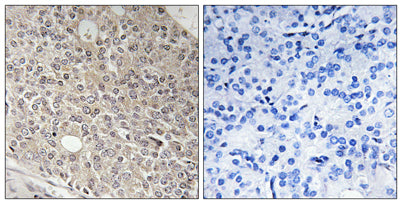
Applications: IHC;IF;ELISA
Reactivity: Human;Mouse
Source: Rabbit
Dilution: Immunohistochemistry: 1/100 - 1/300. ELISA: 1/10000. Not yet tested in other applications.
Immunogen: The antiserum was produced against synthesized peptide derived from human AMOTL1. AA range:441-490
Storage_stability: -20°C/1 year
Clonality: Polyclonal
Isotype: IgG
Concentration: 1 mg/ml
Human_gene_id: 154810
Human_swiss_prot_no: Q8IY63
Subcellular_location: Cell junction, tight junction .
Other_name: AMOTL1; Angiomotin-like protein 1
Background: The protein encoded by this gene is a peripheral membrane protein that is a component of tight junctions or TJs. TJs form an apical junctional structure and act to control paracellular permeability and maintain cell polarity. This protein is related to angiomotin, an angiostatin binding protein that regulates endothelial cell migration and capillary formation. Two transcript variants encoding different isoforms have been found for this gene. [provided by RefSeq, Jul 2014],
Reactivity: Human;Mouse
Source: Rabbit
Dilution: Immunohistochemistry: 1/100 - 1/300. ELISA: 1/10000. Not yet tested in other applications.
Immunogen: The antiserum was produced against synthesized peptide derived from human AMOTL1. AA range:441-490
Storage_stability: -20°C/1 year
Clonality: Polyclonal
Isotype: IgG
Concentration: 1 mg/ml
Human_gene_id: 154810
Human_swiss_prot_no: Q8IY63
Subcellular_location: Cell junction, tight junction .
Other_name: AMOTL1; Angiomotin-like protein 1
Background: The protein encoded by this gene is a peripheral membrane protein that is a component of tight junctions or TJs. TJs form an apical junctional structure and act to control paracellular permeability and maintain cell polarity. This protein is related to angiomotin, an angiostatin binding protein that regulates endothelial cell migration and capillary formation. Two transcript variants encoding different isoforms have been found for this gene. [provided by RefSeq, Jul 2014],
Share