1
/
of
1
ELK Biotechnology
SKU:ES4732
Olfactory receptor 10T2 rabbit pAb
Olfactory receptor 10T2 rabbit pAb
Regular price
$250.00 USD
Regular price
Sale price
$250.00 USD
Unit price
/
per
Shipping calculated at checkout.
Couldn't load pickup availability
Applications: WB;ELISA
Reactivity: Human;Rat;Mouse;
Source: Rabbit
Dilution: Western Blot: 1/500 - 1/2000. ELISA: 1/20000. Not yet tested in other applications.
Immunogen: The antiserum was produced against synthesized peptide derived from human OR10T2. AA range:231-280
Storage_stability: -20°C/1 year
Clonality: Polyclonal
Isotype: IgG
Concentration: 1 mg/ml
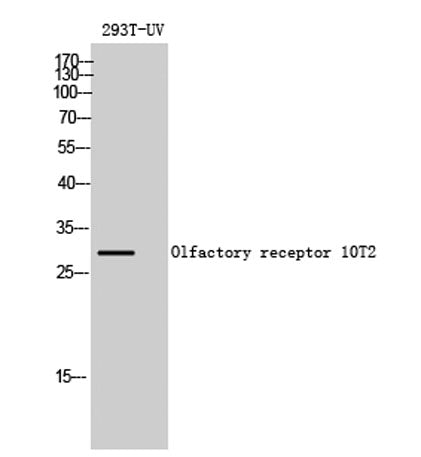
Observed_band(KD): 30kD
Human_gene_id: 128360
Human_swiss_prot_no: Q8NGX3
Subcellular_location: Cell membrane; Multi-pass membrane protein.
Other_name: OR10T2; Olfactory receptor 10T2; Olfactory receptor OR1-3
Background: Olfactory receptors interact with odorant molecules in the nose, to initiate a neuronal response that triggers the perception of a smell. The olfactory receptor proteins are members of a large family of G-protein-coupled receptors (GPCR) arising from single coding-exon genes. Olfactory receptors share a 7-transmembrane domain structure with many neurotransmitter and hormone receptors and are responsible for the recognition and G protein-mediated transduction of odorant signals. The olfactory receptor gene family is the largest in the genome. The nomenclature assigned to the olfactory receptor genes and proteins for this organism is independent of other organisms. [provided by RefSeq, Jul 2008],
Reactivity: Human;Rat;Mouse;
Source: Rabbit
Dilution: Western Blot: 1/500 - 1/2000. ELISA: 1/20000. Not yet tested in other applications.
Immunogen: The antiserum was produced against synthesized peptide derived from human OR10T2. AA range:231-280
Storage_stability: -20°C/1 year
Clonality: Polyclonal
Isotype: IgG
Concentration: 1 mg/ml
Observed_band(KD): 30kD
Human_gene_id: 128360
Human_swiss_prot_no: Q8NGX3
Subcellular_location: Cell membrane; Multi-pass membrane protein.
Other_name: OR10T2; Olfactory receptor 10T2; Olfactory receptor OR1-3
Background: Olfactory receptors interact with odorant molecules in the nose, to initiate a neuronal response that triggers the perception of a smell. The olfactory receptor proteins are members of a large family of G-protein-coupled receptors (GPCR) arising from single coding-exon genes. Olfactory receptors share a 7-transmembrane domain structure with many neurotransmitter and hormone receptors and are responsible for the recognition and G protein-mediated transduction of odorant signals. The olfactory receptor gene family is the largest in the genome. The nomenclature assigned to the olfactory receptor genes and proteins for this organism is independent of other organisms. [provided by RefSeq, Jul 2008],
Share