1
/
of
1
ELK Biotechnology
SKU:ES4714
GPR139 rabbit pAb
GPR139 rabbit pAb
Regular price
$250.00 USD
Regular price
Sale price
$250.00 USD
Unit price
/
per
Shipping calculated at checkout.
Couldn't load pickup availability
Applications: WB;IF;ELISA
Reactivity: Human;Mouse;Rat
Source: Rabbit
Dilution: Western Blot: 1/500 - 1/2000. Immunofluorescence: 1/200 - 1/1000. ELISA: 1/5000. Not yet tested in other applications.
Immunogen: The antiserum was produced against synthesized peptide derived from human GPR139. AA range:181-230
Storage_stability: -20°C/1 year
Clonality: Polyclonal
Isotype: IgG
Concentration: 1 mg/ml
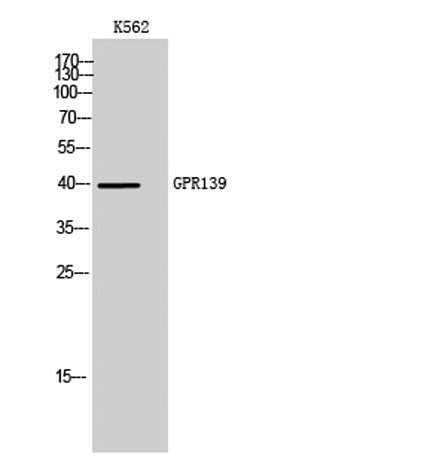
Observed_band(KD): 40kD
Human_gene_id: 124274
Human_swiss_prot_no: Q6DWJ6
Subcellular_location: Cell membrane; Multi-pass membrane protein.
Other_name: GPR139; GPRG1; PGR3; Probable G-protein coupled receptor 139; G(q)-coupled orphan receptor GPRg1; G-protein-coupled receptor PGR3
Background: This gene encodes a member of the rhodopsin family of G-protein-coupled receptors. The encoded protein is almost exclusively expressed in the central nervous system. L-tryptophan and L-phenylalanine may act as the physiologic ligands of the encoded protein. Alternative splicing results in multiple transcript variants. [provided by RefSeq, Jan 2016],
Reactivity: Human;Mouse;Rat
Source: Rabbit
Dilution: Western Blot: 1/500 - 1/2000. Immunofluorescence: 1/200 - 1/1000. ELISA: 1/5000. Not yet tested in other applications.
Immunogen: The antiserum was produced against synthesized peptide derived from human GPR139. AA range:181-230
Storage_stability: -20°C/1 year
Clonality: Polyclonal
Isotype: IgG
Concentration: 1 mg/ml
Observed_band(KD): 40kD
Human_gene_id: 124274
Human_swiss_prot_no: Q6DWJ6
Subcellular_location: Cell membrane; Multi-pass membrane protein.
Other_name: GPR139; GPRG1; PGR3; Probable G-protein coupled receptor 139; G(q)-coupled orphan receptor GPRg1; G-protein-coupled receptor PGR3
Background: This gene encodes a member of the rhodopsin family of G-protein-coupled receptors. The encoded protein is almost exclusively expressed in the central nervous system. L-tryptophan and L-phenylalanine may act as the physiologic ligands of the encoded protein. Alternative splicing results in multiple transcript variants. [provided by RefSeq, Jan 2016],
Share