1
/
of
1
ELK Biotechnology
SKU:ES4583
KDEL Receptor 3 rabbit pAb
KDEL Receptor 3 rabbit pAb
Regular price
$250.00 USD
Regular price
Sale price
$250.00 USD
Unit price
/
per
Shipping calculated at checkout.
Couldn't load pickup availability
Applications: WB;IHC;IF;ELISA
Reactivity: Human;Mouse
Source: Rabbit
Dilution: Western Blot: 1/500 - 1/2000. Immunohistochemistry: 1/100 - 1/300. ELISA: 1/20000. Not yet tested in other applications.
Immunogen: The antiserum was produced against synthesized peptide derived from human ERD23. AA range:61-110
Storage_stability: -20°C/1 year
Clonality: Polyclonal
Isotype: IgG
Concentration: 1 mg/ml
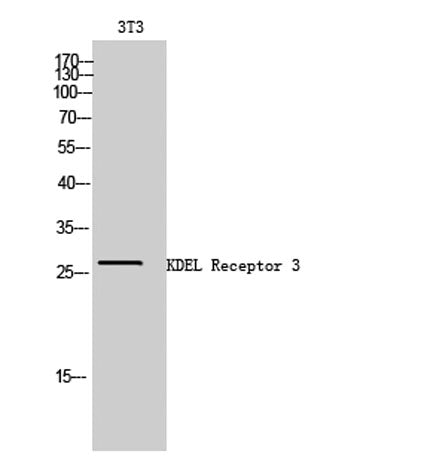
Observed_band(KD): 28kD
Human_gene_id: 11015
Human_swiss_prot_no: O43731
Subcellular_location: Endoplasmic reticulum membrane ; Multi-pass membrane protein . Golgi apparatus membrane ; Multi-pass membrane protein . Cytoplasmic vesicle, COPI-coated vesicle membrane ; Multi-pass membrane protein . Localized in the Golgi in the absence of bound proteins with the sequence motif K-D-E-L. Trafficks back to the endoplasmic reticulum together with cargo proteins containing the sequence motif K-D-E-L. .
Other_name: KDELR3; ER lumen protein retaining receptor 3; KDEL endoplasmic reticulum protein retention receptor 3; KDEL receptor 3
Background: KDEL endoplasmic reticulum protein retention receptor 3(KDELR3) Homo sapiens This gene encodes a member of the KDEL endoplasmic reticulum protein retention receptor family. Retention of resident soluble proteins in the lumen of the endoplasmic reticulum (ER) is achieved in both yeast and animal cells by their continual retrieval from the cis-Golgi, or a pre-Golgi compartment. Sorting of these proteins is dependent on a C-terminal tetrapeptide signal, usually lys-asp-glu-leu (KDEL) in animal cells, and his-asp-glu-leu (HDEL) in S. cerevisiae. This process is mediated by a receptor that recognizes, and binds the tetrapeptide-containing protein, and returns it to the ER. In yeast, the sorting receptor encoded by a single gene, ERD2, is a seven-transmembrane protein. Unlike yeast, several human homologs of the ERD2 gene, constituting the KDEL receptor gene family, have been described. KDELR3 was the third member of the family to be identified. Alt
Reactivity: Human;Mouse
Source: Rabbit
Dilution: Western Blot: 1/500 - 1/2000. Immunohistochemistry: 1/100 - 1/300. ELISA: 1/20000. Not yet tested in other applications.
Immunogen: The antiserum was produced against synthesized peptide derived from human ERD23. AA range:61-110
Storage_stability: -20°C/1 year
Clonality: Polyclonal
Isotype: IgG
Concentration: 1 mg/ml
Observed_band(KD): 28kD
Human_gene_id: 11015
Human_swiss_prot_no: O43731
Subcellular_location: Endoplasmic reticulum membrane ; Multi-pass membrane protein . Golgi apparatus membrane ; Multi-pass membrane protein . Cytoplasmic vesicle, COPI-coated vesicle membrane ; Multi-pass membrane protein . Localized in the Golgi in the absence of bound proteins with the sequence motif K-D-E-L. Trafficks back to the endoplasmic reticulum together with cargo proteins containing the sequence motif K-D-E-L. .
Other_name: KDELR3; ER lumen protein retaining receptor 3; KDEL endoplasmic reticulum protein retention receptor 3; KDEL receptor 3
Background: KDEL endoplasmic reticulum protein retention receptor 3(KDELR3) Homo sapiens This gene encodes a member of the KDEL endoplasmic reticulum protein retention receptor family. Retention of resident soluble proteins in the lumen of the endoplasmic reticulum (ER) is achieved in both yeast and animal cells by their continual retrieval from the cis-Golgi, or a pre-Golgi compartment. Sorting of these proteins is dependent on a C-terminal tetrapeptide signal, usually lys-asp-glu-leu (KDEL) in animal cells, and his-asp-glu-leu (HDEL) in S. cerevisiae. This process is mediated by a receptor that recognizes, and binds the tetrapeptide-containing protein, and returns it to the ER. In yeast, the sorting receptor encoded by a single gene, ERD2, is a seven-transmembrane protein. Unlike yeast, several human homologs of the ERD2 gene, constituting the KDEL receptor gene family, have been described. KDELR3 was the third member of the family to be identified. Alt
Share