1
/
of
1
ELK Biotechnology
SKU:ES4510
CENP-A (phospho Ser7) rabbit pAb
CENP-A (phospho Ser7) rabbit pAb
Regular price
$250.00 USD
Regular price
Sale price
$250.00 USD
Unit price
/
per
Shipping calculated at checkout.
Couldn't load pickup availability
Applications: IF;ELISA
Reactivity: Human;Rat;Mouse;
Source: Rabbit
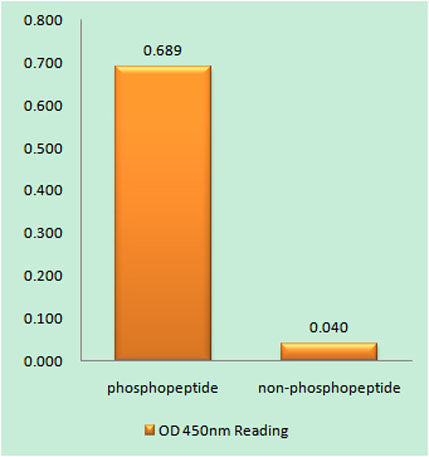
Dilution: Immunofluorescence: 1/200 - 1/1000. ELISA: 1/10000. Not yet tested in other applications.
Immunogen: The antiserum was produced against synthesized peptide derived from human Centromeric Protein A around the phosphorylation site of Ser7. AA range:1-50
Storage_stability: -20°C/1 year
Clonality: Polyclonal
Isotype: IgG
Concentration: 1 mg/ml
Human_gene_id: 1058
Human_swiss_prot_no: P49450
Subcellular_location: Nucleus . Chromosome, centromere, kinetochore . Chromosome, centromere . Localizes exclusively in the kinetochore domain of centromeres. Occupies a compact domain at the inner kinetochore plate stretching across 2 thirds of the length of the constriction but encompassing only one third of the constriction width and height (PubMed:19114591). Phosphorylation at Ser-68 during early mitosis abolishes association with chromatin and centromeres and results in dispersed nuclear location (PubMed:25556658). .
Other_name: CENPA; Histone H3-like centromeric protein A; Centromere autoantigen A; Centromere protein A; CENP-A
Background: Centromeres are the differentiated chromosomal domains that specify the mitotic behavior of chromosomes. This gene encodes a centromere protein which contains a histone H3 related histone fold domain that is required for targeting to the centromere. Centromere protein A is proposed to be a component of a modified nucleosome or nucleosome-like structure in which it replaces 1 or both copies of conventional histone H3 in the (H3-H4)2 tetrameric core of the nucleosome particle. The protein is a replication-independent histone that is a member of the histone H3 family. Alternative splicing results in multiple transcript variants encoding distinct isoforms. [provided by RefSeq, Nov 2015],
Reactivity: Human;Rat;Mouse;
Source: Rabbit
Dilution: Immunofluorescence: 1/200 - 1/1000. ELISA: 1/10000. Not yet tested in other applications.
Immunogen: The antiserum was produced against synthesized peptide derived from human Centromeric Protein A around the phosphorylation site of Ser7. AA range:1-50
Storage_stability: -20°C/1 year
Clonality: Polyclonal
Isotype: IgG
Concentration: 1 mg/ml
Human_gene_id: 1058
Human_swiss_prot_no: P49450
Subcellular_location: Nucleus . Chromosome, centromere, kinetochore . Chromosome, centromere . Localizes exclusively in the kinetochore domain of centromeres. Occupies a compact domain at the inner kinetochore plate stretching across 2 thirds of the length of the constriction but encompassing only one third of the constriction width and height (PubMed:19114591). Phosphorylation at Ser-68 during early mitosis abolishes association with chromatin and centromeres and results in dispersed nuclear location (PubMed:25556658). .
Other_name: CENPA; Histone H3-like centromeric protein A; Centromere autoantigen A; Centromere protein A; CENP-A
Background: Centromeres are the differentiated chromosomal domains that specify the mitotic behavior of chromosomes. This gene encodes a centromere protein which contains a histone H3 related histone fold domain that is required for targeting to the centromere. Centromere protein A is proposed to be a component of a modified nucleosome or nucleosome-like structure in which it replaces 1 or both copies of conventional histone H3 in the (H3-H4)2 tetrameric core of the nucleosome particle. The protein is a replication-independent histone that is a member of the histone H3 family. Alternative splicing results in multiple transcript variants encoding distinct isoforms. [provided by RefSeq, Nov 2015],
Share