1
/
of
1
ELK Biotechnology
SKU:ES3685
Vasohibin rabbit pAb
Vasohibin rabbit pAb
Regular price
$250.00 USD
Regular price
Sale price
$250.00 USD
Unit price
/
per
Shipping calculated at checkout.
Couldn't load pickup availability
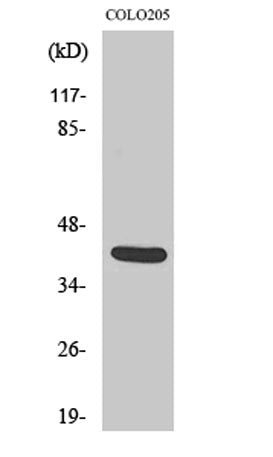
Applications: WB;ELISA
Reactivity: Human;Mouse;Rat
Source: Rabbit
Dilution: Western Blot: 1/500 - 1/2000. ELISA: 1/40000. Not yet tested in other applications.
Immunogen: The antiserum was produced against synthesized peptide derived from human VASH1. AA range:261-310
Storage_stability: -20°C/1 year
Clonality: Polyclonal
Isotype: IgG
Concentration: 1 mg/ml
Observed_band(KD): 40kD
Human_gene_id: 22846
Human_swiss_prot_no: Q7L8A9
Subcellular_location: Cytoplasm . Secreted . Mainly localizes in the cytoplasm (PubMed:27879017). Some fraction is secreted via a non-canonical secretion system; interaction with SVBP promotes secretion (PubMed:27879017). .
Other_name: VASH1; KIAA1036; VASH; Vasohibin-1
Background: caution:Although probably secreted, it lacks a canonical signal sequence.,function:Angiogenesis inhibitor. Inhibits migration, proliferation and network formation by endothelial cells as well as angiogenesis. This inhibitory effect is selective to endothelial cells as it does not affect the migration of smooth muscle cells or fibroblasts. Does not affect the proliferation of cancer cells in vitro, but inhibits tumor growth and tumor angiogenesis. Acts in an autocrine manner. Inhibits artery neointimal formation and macrophage infiltration. Exhibits heparin-binding activity.,induction:By VEGF.,PTM:2 major forms (42 and 36 kDa) and 2 minors (32 and 27 kDa) may be processed by proteolytic cleavage. The largest form (42 kDa) seems to be secreted and the other major form (63 kDa) seems to accumulate within the cells or pericellular milieu. Polypeptide consisting of Met-77 to Arg-318 may correspond to the 27 kDa form and that consisting of Met-77 to Val-365 may correspond to the 36 kDa form.,similarity:Belongs to the vasohibin family.,tissue specificity:Preferentially expressed in endothelial cells. Highly expressed in fetal organs. Expressed in brain and placenta, and at lower level in heart and kidney. Highly detected in microvessels endothelial cells of atherosclerotic lesions.,
Reactivity: Human;Mouse;Rat
Source: Rabbit
Dilution: Western Blot: 1/500 - 1/2000. ELISA: 1/40000. Not yet tested in other applications.
Immunogen: The antiserum was produced against synthesized peptide derived from human VASH1. AA range:261-310
Storage_stability: -20°C/1 year
Clonality: Polyclonal
Isotype: IgG
Concentration: 1 mg/ml
Observed_band(KD): 40kD
Human_gene_id: 22846
Human_swiss_prot_no: Q7L8A9
Subcellular_location: Cytoplasm . Secreted . Mainly localizes in the cytoplasm (PubMed:27879017). Some fraction is secreted via a non-canonical secretion system; interaction with SVBP promotes secretion (PubMed:27879017). .
Other_name: VASH1; KIAA1036; VASH; Vasohibin-1
Background: caution:Although probably secreted, it lacks a canonical signal sequence.,function:Angiogenesis inhibitor. Inhibits migration, proliferation and network formation by endothelial cells as well as angiogenesis. This inhibitory effect is selective to endothelial cells as it does not affect the migration of smooth muscle cells or fibroblasts. Does not affect the proliferation of cancer cells in vitro, but inhibits tumor growth and tumor angiogenesis. Acts in an autocrine manner. Inhibits artery neointimal formation and macrophage infiltration. Exhibits heparin-binding activity.,induction:By VEGF.,PTM:2 major forms (42 and 36 kDa) and 2 minors (32 and 27 kDa) may be processed by proteolytic cleavage. The largest form (42 kDa) seems to be secreted and the other major form (63 kDa) seems to accumulate within the cells or pericellular milieu. Polypeptide consisting of Met-77 to Arg-318 may correspond to the 27 kDa form and that consisting of Met-77 to Val-365 may correspond to the 36 kDa form.,similarity:Belongs to the vasohibin family.,tissue specificity:Preferentially expressed in endothelial cells. Highly expressed in fetal organs. Expressed in brain and placenta, and at lower level in heart and kidney. Highly detected in microvessels endothelial cells of atherosclerotic lesions.,
Share