1
/
of
1
ELK Biotechnology
SKU:ES3426
Septin 7 rabbit pAb
Septin 7 rabbit pAb
Regular price
$250.00 USD
Regular price
Sale price
$250.00 USD
Unit price
/
per
Shipping calculated at checkout.
Couldn't load pickup availability
Applications: WB;IHC;IF;ELISA
Reactivity: Human;Mouse;Rat
Source: Rabbit
Dilution: Western Blot: 1/500 - 1/2000.IHC-p:1:50-300 ELISA: 1/20000. Not yet tested in other applications.
Immunogen: The antiserum was produced against synthesized peptide derived from human SEPT7. AA range:350-399
Storage_stability: -20°C/1 year
Clonality: Polyclonal
Isotype: IgG
Concentration: 1 mg/ml
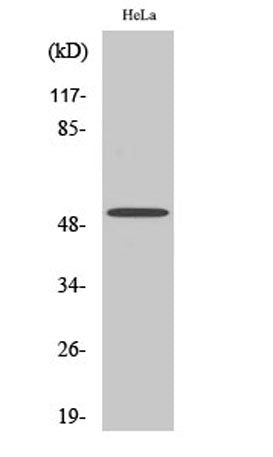
Observed_band(KD): 48kD
Human_gene_id: 989
Human_swiss_prot_no: Q16181
Subcellular_location: Cytoplasm . Chromosome, centromere, kinetochore . Cytoplasm, cytoskeleton, spindle . Cleavage furrow . Midbody . Cytoplasm, cytoskeleton, cilium axoneme . Cell projection, cilium, flagellum . Distributed throughout the cytoplasm in prometaphase cells. Associated with the spindle during metaphase. Associated with the central spindle and at the cleavage furrow in anaphase cells. Detected at the midbody in telophase. Associated with actin stress fibers (By similarity). Found in the sperm annulus (PubMed:25588830). .
Other_name: SEPT7; CDC10; Septin-7; CDC10 protein homolog
Background: septin 7(SEPT7) Homo sapiens This gene encodes a protein that is highly similar to the CDC10 protein of Saccharomyces cerevisiae. The protein also shares similarity with Diff 6 of Drosophila and with H5 of mouse. Each of these similar proteins, including the yeast CDC10, contains a GTP-binding motif. The yeast CDC10 protein is a structural component of the 10 nm filament which lies inside the cytoplasmic membrane and is essential for cytokinesis. This human protein functions in gliomagenesis and in the suppression of glioma cell growth, and it is required for the association of centromere-associated protein E with the kinetochore. Alternative splicing results in multiple transcript variants. Several related pseudogenes have been identified on chromosomes 5, 7, 9, 10, 11, 14, 17 and 19. [provided by RefSeq, Jul 2011],
Reactivity: Human;Mouse;Rat
Source: Rabbit
Dilution: Western Blot: 1/500 - 1/2000.IHC-p:1:50-300 ELISA: 1/20000. Not yet tested in other applications.
Immunogen: The antiserum was produced against synthesized peptide derived from human SEPT7. AA range:350-399
Storage_stability: -20°C/1 year
Clonality: Polyclonal
Isotype: IgG
Concentration: 1 mg/ml
Observed_band(KD): 48kD
Human_gene_id: 989
Human_swiss_prot_no: Q16181
Subcellular_location: Cytoplasm . Chromosome, centromere, kinetochore . Cytoplasm, cytoskeleton, spindle . Cleavage furrow . Midbody . Cytoplasm, cytoskeleton, cilium axoneme . Cell projection, cilium, flagellum . Distributed throughout the cytoplasm in prometaphase cells. Associated with the spindle during metaphase. Associated with the central spindle and at the cleavage furrow in anaphase cells. Detected at the midbody in telophase. Associated with actin stress fibers (By similarity). Found in the sperm annulus (PubMed:25588830). .
Other_name: SEPT7; CDC10; Septin-7; CDC10 protein homolog
Background: septin 7(SEPT7) Homo sapiens This gene encodes a protein that is highly similar to the CDC10 protein of Saccharomyces cerevisiae. The protein also shares similarity with Diff 6 of Drosophila and with H5 of mouse. Each of these similar proteins, including the yeast CDC10, contains a GTP-binding motif. The yeast CDC10 protein is a structural component of the 10 nm filament which lies inside the cytoplasmic membrane and is essential for cytokinesis. This human protein functions in gliomagenesis and in the suppression of glioma cell growth, and it is required for the association of centromere-associated protein E with the kinetochore. Alternative splicing results in multiple transcript variants. Several related pseudogenes have been identified on chromosomes 5, 7, 9, 10, 11, 14, 17 and 19. [provided by RefSeq, Jul 2011],
Share