1
/
of
1
ELK Biotechnology
SKU:ES3325
Rap 2C rabbit pAb
Rap 2C rabbit pAb
Regular price
$250.00 USD
Regular price
Sale price
$250.00 USD
Unit price
/
per
Shipping calculated at checkout.
Couldn't load pickup availability
Applications: WB;IHC
Reactivity: Human;Mouse
Source: Rabbit
Dilution: WB 1:500-2000;IHC-p 1:50-300
Immunogen: The antiserum was produced against synthesized peptide derived from human RAP2C. AA range:97-146
Storage_stability: -20°C/1 year
Clonality: Polyclonal
Isotype: IgG
Concentration: 1 mg/ml
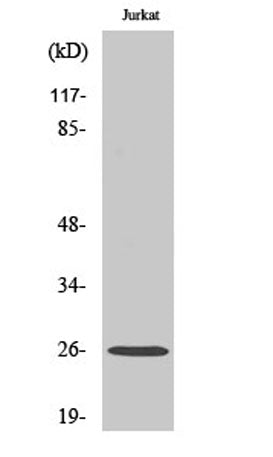
Observed_band(KD): 26kD
Human_gene_id: 57826
Human_swiss_prot_no: Q9Y3L5
Subcellular_location: Cytoplasm . Recycling endosome membrane ; Lipid-anchor ; Cytoplasmic side .
Other_name: RAP2C; Ras-related protein Rap-2c
Background: The protein encoded by this gene is a member of the Ras-related protein subfamily of the Ras GTPase superfamily. Members of this family are small GTPases that act as molecular switches to regulate cellular proliferation, differentiation, and apoptosis. This protein has been reported to activate in vitro transcriptional activity of the serum response element. Alternative splicing results in multiple transcript variants. [provided by RefSeq, Sep 2012],
Reactivity: Human;Mouse
Source: Rabbit
Dilution: WB 1:500-2000;IHC-p 1:50-300
Immunogen: The antiserum was produced against synthesized peptide derived from human RAP2C. AA range:97-146
Storage_stability: -20°C/1 year
Clonality: Polyclonal
Isotype: IgG
Concentration: 1 mg/ml
Observed_band(KD): 26kD
Human_gene_id: 57826
Human_swiss_prot_no: Q9Y3L5
Subcellular_location: Cytoplasm . Recycling endosome membrane ; Lipid-anchor ; Cytoplasmic side .
Other_name: RAP2C; Ras-related protein Rap-2c
Background: The protein encoded by this gene is a member of the Ras-related protein subfamily of the Ras GTPase superfamily. Members of this family are small GTPases that act as molecular switches to regulate cellular proliferation, differentiation, and apoptosis. This protein has been reported to activate in vitro transcriptional activity of the serum response element. Alternative splicing results in multiple transcript variants. [provided by RefSeq, Sep 2012],
Share