1
/
of
1
ELK Biotechnology
SKU:ES2626
InsP6 Kinase 3 rabbit pAb
InsP6 Kinase 3 rabbit pAb
Regular price
$250.00 USD
Regular price
Sale price
$250.00 USD
Unit price
/
per
Shipping calculated at checkout.
Couldn't load pickup availability
Applications: WB;IHC;IF;ELISA
Reactivity: Human;Mouse
Source: Rabbit
Dilution: Western Blot: 1/500 - 1/2000. Immunohistochemistry: 1/100 - 1/300. Immunofluorescence: 1/200 - 1/1000. ELISA: 1/20000. Not yet tested in other applications.
Immunogen: The antiserum was produced against synthesized peptide derived from human IP6K3. AA range:201-250
Storage_stability: -20°C/1 year
Clonality: Polyclonal
Isotype: IgG
Concentration: 1 mg/ml
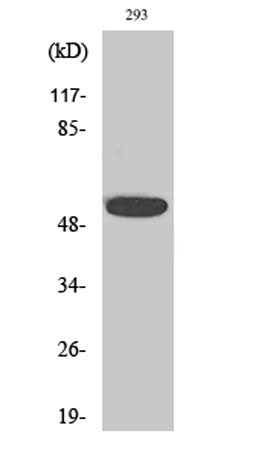
Observed_band(KD): 51kD
Human_gene_id: 117283
Human_swiss_prot_no: Q96PC2
Subcellular_location: Cytoplasm .
Other_name: IP6K3; IHPK3; Inositol hexakisphosphate kinase 3; InsP6 kinase 3; Inositol hexaphosphate kinase 3
Background: This gene encodes a protein that belongs to the inositol phosphokinase (IPK) family. This protein is likely responsible for the conversion of inositol hexakisphosphate (InsP6) to diphosphoinositol pentakisphosphate (InsP7/PP-InsP5). It may also convert 1,3,4,5,6-pentakisphosphate (InsP5) to PP-InsP4. Alternative splicing results in multiple transcript variants encoding the same protein.[provided by RefSeq, Dec 2008],
Reactivity: Human;Mouse
Source: Rabbit
Dilution: Western Blot: 1/500 - 1/2000. Immunohistochemistry: 1/100 - 1/300. Immunofluorescence: 1/200 - 1/1000. ELISA: 1/20000. Not yet tested in other applications.
Immunogen: The antiserum was produced against synthesized peptide derived from human IP6K3. AA range:201-250
Storage_stability: -20°C/1 year
Clonality: Polyclonal
Isotype: IgG
Concentration: 1 mg/ml
Observed_band(KD): 51kD
Human_gene_id: 117283
Human_swiss_prot_no: Q96PC2
Subcellular_location: Cytoplasm .
Other_name: IP6K3; IHPK3; Inositol hexakisphosphate kinase 3; InsP6 kinase 3; Inositol hexaphosphate kinase 3
Background: This gene encodes a protein that belongs to the inositol phosphokinase (IPK) family. This protein is likely responsible for the conversion of inositol hexakisphosphate (InsP6) to diphosphoinositol pentakisphosphate (InsP7/PP-InsP5). It may also convert 1,3,4,5,6-pentakisphosphate (InsP5) to PP-InsP4. Alternative splicing results in multiple transcript variants encoding the same protein.[provided by RefSeq, Dec 2008],
Share