1
/
of
1
ELK Biotechnology
SKU:ES2497
Hck rabbit pAb
Hck rabbit pAb
Regular price
$250.00 USD
Regular price
Sale price
$250.00 USD
Unit price
/
per
Shipping calculated at checkout.
Couldn't load pickup availability
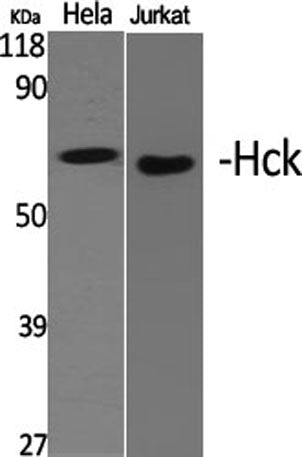
Applications: WB;IHC;IF;ELISA
Reactivity: Human;Mouse;Rat
Source: Rabbit
Dilution: Immunohistochemistry: 1/100 - 1/300. Immunofluorescence: 1/200 - 1/1000. ELISA: 1/5000. Not yet tested in other applications.
Immunogen: The antiserum was produced against synthesized peptide derived from human HCK. AA range:381-430
Storage_stability: -20°C/1 year
Clonality: Polyclonal
Isotype: IgG
Concentration: 1 mg/ml
Human_gene_id: 3055
Human_swiss_prot_no: P08631
Subcellular_location: [Isoform 1]: Lysosome. Membrane; Lipid-anchor. Cell projection, podosome membrane; Lipid-anchor. Cytoplasm, cytosol. Associated with specialized secretory lysosomes called azurophil granules. At least half of this isoform is found in the cytoplasm, some of this fraction is myristoylated.; [Isoform 2]: Cell membrane ; Lipid-anchor . Membrane, caveola ; Lipid-anchor . Cell junction, focal adhesion . Cytoplasm, cytoskeleton . Golgi apparatus . Cytoplasmic vesicle . Lysosome . Nucleus . 20% of this isoform is associated with caveolae. Localization at the cell membrane and at caveolae requires palmitoylation at Cys-3. Colocalizes with the actin cytoskeleton at focal adhesions.; Cytoplasmic vesicle, secretory vesicle. Cytoplasm, cytosol.
Other_name: HCK; Tyrosine-protein kinase HCK; Hematopoietic cell kinase; Hemopoietic cell kinase; p59-HCK/p60-HCK; p59Hck; p61Hck
Background: The protein encoded by this gene is a member of the Src family of tyrosine kinases. This protein is primarily hemopoietic, particularly in cells of the myeloid and B-lymphoid lineages. It may help couple the Fc receptor to the activation of the respiratory burst. In addition, it may play a role in neutrophil migration and in the degranulation of neutrophils. Multiple isoforms with different subcellular distributions are produced due to both alternative splicing and the use of alternative translation initiation codons, including a non-AUG (CUG) codon. [provided by RefSeq, Feb 2010],
Reactivity: Human;Mouse;Rat
Source: Rabbit
Dilution: Immunohistochemistry: 1/100 - 1/300. Immunofluorescence: 1/200 - 1/1000. ELISA: 1/5000. Not yet tested in other applications.
Immunogen: The antiserum was produced against synthesized peptide derived from human HCK. AA range:381-430
Storage_stability: -20°C/1 year
Clonality: Polyclonal
Isotype: IgG
Concentration: 1 mg/ml
Human_gene_id: 3055
Human_swiss_prot_no: P08631
Subcellular_location: [Isoform 1]: Lysosome. Membrane; Lipid-anchor. Cell projection, podosome membrane; Lipid-anchor. Cytoplasm, cytosol. Associated with specialized secretory lysosomes called azurophil granules. At least half of this isoform is found in the cytoplasm, some of this fraction is myristoylated.; [Isoform 2]: Cell membrane ; Lipid-anchor . Membrane, caveola ; Lipid-anchor . Cell junction, focal adhesion . Cytoplasm, cytoskeleton . Golgi apparatus . Cytoplasmic vesicle . Lysosome . Nucleus . 20% of this isoform is associated with caveolae. Localization at the cell membrane and at caveolae requires palmitoylation at Cys-3. Colocalizes with the actin cytoskeleton at focal adhesions.; Cytoplasmic vesicle, secretory vesicle. Cytoplasm, cytosol.
Other_name: HCK; Tyrosine-protein kinase HCK; Hematopoietic cell kinase; Hemopoietic cell kinase; p59-HCK/p60-HCK; p59Hck; p61Hck
Background: The protein encoded by this gene is a member of the Src family of tyrosine kinases. This protein is primarily hemopoietic, particularly in cells of the myeloid and B-lymphoid lineages. It may help couple the Fc receptor to the activation of the respiratory burst. In addition, it may play a role in neutrophil migration and in the degranulation of neutrophils. Multiple isoforms with different subcellular distributions are produced due to both alternative splicing and the use of alternative translation initiation codons, including a non-AUG (CUG) codon. [provided by RefSeq, Feb 2010],
Share