1
/
of
1
ELK Biotechnology
SKU:ES20156
Cyclin D1 (Phospho Ser90) rabbit pAb
Cyclin D1 (Phospho Ser90) rabbit pAb
Regular price
$250.00 USD
Regular price
Sale price
$250.00 USD
Unit price
/
per
Shipping calculated at checkout.
Couldn't load pickup availability
Applications: WB; ELISA
Reactivity: Human;Mouse;Rat
Source: Rabbit
Dilution: WB 1:1000-2000 ELISA 1:5000-20000
Immunogen: Synthesized peptide derived from human Cyclin D1 (Phospho Ser90)
Storage_stability: -20°C/1 year
Clonality: Polyclonal
Isotype: IgG
Concentration: 1 mg/ml
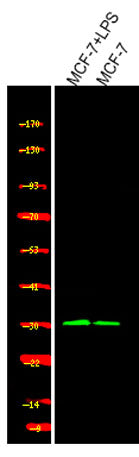
Observed_band(KD): 33kD
Human_gene_id: 595
Human_swiss_prot_no: P24385
Subcellular_location: Nucleus . Cytoplasm . Nucleus membrane . Cyclin D-CDK4 complexes accumulate at the nuclear membrane and are then translocated to the nucleus through interaction with KIP/CIP family members. .
Other_name: G1/S-specific cyclin-D1 (B-cell lymphoma 1 protein;BCL-1;BCL-1 oncogene;PRAD1 oncogene)
Background: disease:A chromosomal aberration involving CCND1 may be a cause of B-lymphocytic malignancy, particularly mantle-cell lymphoma (MCL). Translocation t(11;14)(q13;q32) with immunoglobulin gene regions. Activation of CCND1 may be oncogenic by directly altering progression through the cell cycle.,disease:A chromosomal aberration involving CCND1 may be a cause of multiple myeloma [MIM:254500]. Translocation t(11;14)(q13;q32) with the IgH locus.,disease:A chromosomal aberration involving CCND1 may be a cause of parathyroid adenomas [MIM:168461]. Translocation t(11;11)(q13;p15) with the parathyroid hormone (PTH) enhancer.,function:Essential for the control of the cell cycle at the G1/S (start) transition.,online information:The Singapore human mutation and polymorphism database,PTM:Following DNA damage it is ubiquitinated by some SCF (SKP1-cullin-F-box) protein ligase complex containing FBXO31. Ubiquitination leads to its degradation and G1 arrest.,PTM:Phosphorylation at Thr-286 by MAP kinases is required for ubiquitination and degradation following DNA damage. It probably plays an essential role for recognition by the FBXO31 component of SCF (SKP1-cullin-F-box) protein ligase complex.,similarity:Belongs to the cyclin family.,similarity:Belongs to the cyclin family. Cyclin D subfamily.,subunit:Interacts with the CDK4 and CDK6 protein kinases to form a serine/threonine kinase holoenzyme complex. The cyclin subunit imparts substrate specificity to the complex.,
Reactivity: Human;Mouse;Rat
Source: Rabbit
Dilution: WB 1:1000-2000 ELISA 1:5000-20000
Immunogen: Synthesized peptide derived from human Cyclin D1 (Phospho Ser90)
Storage_stability: -20°C/1 year
Clonality: Polyclonal
Isotype: IgG
Concentration: 1 mg/ml
Observed_band(KD): 33kD
Human_gene_id: 595
Human_swiss_prot_no: P24385
Subcellular_location: Nucleus . Cytoplasm . Nucleus membrane . Cyclin D-CDK4 complexes accumulate at the nuclear membrane and are then translocated to the nucleus through interaction with KIP/CIP family members. .
Other_name: G1/S-specific cyclin-D1 (B-cell lymphoma 1 protein;BCL-1;BCL-1 oncogene;PRAD1 oncogene)
Background: disease:A chromosomal aberration involving CCND1 may be a cause of B-lymphocytic malignancy, particularly mantle-cell lymphoma (MCL). Translocation t(11;14)(q13;q32) with immunoglobulin gene regions. Activation of CCND1 may be oncogenic by directly altering progression through the cell cycle.,disease:A chromosomal aberration involving CCND1 may be a cause of multiple myeloma [MIM:254500]. Translocation t(11;14)(q13;q32) with the IgH locus.,disease:A chromosomal aberration involving CCND1 may be a cause of parathyroid adenomas [MIM:168461]. Translocation t(11;11)(q13;p15) with the parathyroid hormone (PTH) enhancer.,function:Essential for the control of the cell cycle at the G1/S (start) transition.,online information:The Singapore human mutation and polymorphism database,PTM:Following DNA damage it is ubiquitinated by some SCF (SKP1-cullin-F-box) protein ligase complex containing FBXO31. Ubiquitination leads to its degradation and G1 arrest.,PTM:Phosphorylation at Thr-286 by MAP kinases is required for ubiquitination and degradation following DNA damage. It probably plays an essential role for recognition by the FBXO31 component of SCF (SKP1-cullin-F-box) protein ligase complex.,similarity:Belongs to the cyclin family.,similarity:Belongs to the cyclin family. Cyclin D subfamily.,subunit:Interacts with the CDK4 and CDK6 protein kinases to form a serine/threonine kinase holoenzyme complex. The cyclin subunit imparts substrate specificity to the complex.,
Share