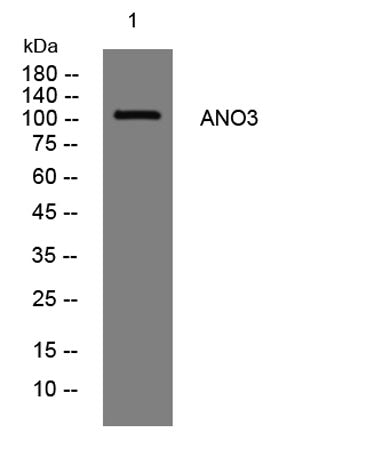
1
/
of
1
ELK Biotechnology
SKU:ES18338
ANO3 rabbit pAb
ANO3 rabbit pAb
Regular price
$250.00 USD
Regular price
Sale price
$250.00 USD
Unit price
/
per
Shipping calculated at checkout.
Couldn't load pickup availability
Applications: WB
Reactivity: Human; Mouse
Source: Rabbit
Dilution: WB 1:500-2000
Immunogen: Synthesized peptide derived from human ANO3 AA range: 518-568
Storage_stability: -20°C/1 year
Clonality: Polyclonal
Isotype: IgG
Concentration: 1 mg/ml
Human_gene_id: 63982
Human_swiss_prot_no: Q9BYT9
Subcellular_location: Cell membrane ; Multi-pass membrane protein . Shows an intracellular localization. .
Background: The protein encoded by this gene belongs to the TMEM16 family of predicted membrane proteins, that are also known as anoctamins. While little is known about the function of this gene, mutations in this gene have been associated with some cases of autosomal dominant craniocervical dystonia. Cells from individuals with a mutation in this gene exhibited abnormalities in endoplasmic reticulum-dependent calcium signaling. Studies in rat show that the rat ortholog of this protein interacts with, and modulates the activity of a sodium-activated potassium channel. Deletion of this gene caused increased pain sensitivity in the rat model system. Alternative splicing results in multiple transcript variants encoding different isoforms. [provided by RefSeq, Aug 2015],
Reactivity: Human; Mouse
Source: Rabbit
Dilution: WB 1:500-2000
Immunogen: Synthesized peptide derived from human ANO3 AA range: 518-568
Storage_stability: -20°C/1 year
Clonality: Polyclonal
Isotype: IgG
Concentration: 1 mg/ml
Human_gene_id: 63982
Human_swiss_prot_no: Q9BYT9
Subcellular_location: Cell membrane ; Multi-pass membrane protein . Shows an intracellular localization. .
Background: The protein encoded by this gene belongs to the TMEM16 family of predicted membrane proteins, that are also known as anoctamins. While little is known about the function of this gene, mutations in this gene have been associated with some cases of autosomal dominant craniocervical dystonia. Cells from individuals with a mutation in this gene exhibited abnormalities in endoplasmic reticulum-dependent calcium signaling. Studies in rat show that the rat ortholog of this protein interacts with, and modulates the activity of a sodium-activated potassium channel. Deletion of this gene caused increased pain sensitivity in the rat model system. Alternative splicing results in multiple transcript variants encoding different isoforms. [provided by RefSeq, Aug 2015],
Share