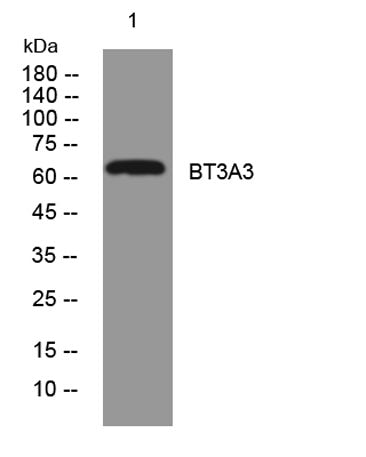
1
/
of
1
ELK Biotechnology
SKU:ES17947
BT3A3 rabbit pAb
BT3A3 rabbit pAb
Regular price
$250.00 USD
Regular price
Sale price
$250.00 USD
Unit price
/
per
Shipping calculated at checkout.
Couldn't load pickup availability
Applications: WB
Reactivity: Human;Rat;Mouse;
Source: Rabbit
Dilution: WB 1:500-2000
Immunogen: Synthesized peptide derived from human BT3A3 AA range: 148-198
Storage_stability: -20°C/1 year
Clonality: Polyclonal
Isotype: IgG
Concentration: 1 mg/ml
Human_gene_id: 10384
Human_swiss_prot_no: O00478
Subcellular_location: Cell membrane ; Single-pass type I membrane protein .
Background: The butyrophilin (BTN) genes are a group of major histocompatibility complex (MHC)-associated genes that encode type I membrane proteins with 2 extracellular immunoglobulin (Ig) domains and an intracellular B30.2 (PRYSPRY) domain. Three subfamilies of human BTN genes are located in the MHC class I region: the single-copy BTN1A1 gene (MIM 601610) and the BTN2 (e.g., BTN2A1; MIM 613590) and BTN3 (e.g., BNT3A3) genes, which have undergone tandem duplication, resulting in 3 copies of each (summary by Smith et al., 2010 [PubMed 20208008]).[supplied by OMIM, Nov 2010],
Reactivity: Human;Rat;Mouse;
Source: Rabbit
Dilution: WB 1:500-2000
Immunogen: Synthesized peptide derived from human BT3A3 AA range: 148-198
Storage_stability: -20°C/1 year
Clonality: Polyclonal
Isotype: IgG
Concentration: 1 mg/ml
Human_gene_id: 10384
Human_swiss_prot_no: O00478
Subcellular_location: Cell membrane ; Single-pass type I membrane protein .
Background: The butyrophilin (BTN) genes are a group of major histocompatibility complex (MHC)-associated genes that encode type I membrane proteins with 2 extracellular immunoglobulin (Ig) domains and an intracellular B30.2 (PRYSPRY) domain. Three subfamilies of human BTN genes are located in the MHC class I region: the single-copy BTN1A1 gene (MIM 601610) and the BTN2 (e.g., BTN2A1; MIM 613590) and BTN3 (e.g., BNT3A3) genes, which have undergone tandem duplication, resulting in 3 copies of each (summary by Smith et al., 2010 [PubMed 20208008]).[supplied by OMIM, Nov 2010],
Share