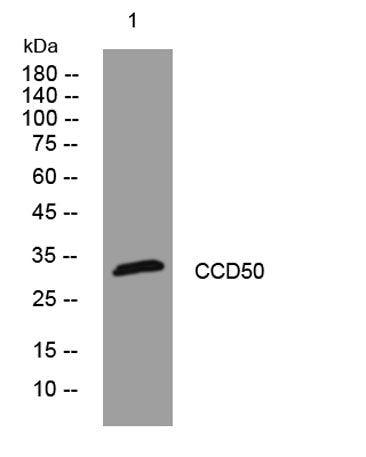
1
/
of
1
ELK Biotechnology
SKU:ES17777
CCD50 rabbit pAb
CCD50 rabbit pAb
Regular price
$250.00 USD
Regular price
Sale price
$250.00 USD
Unit price
/
per
Shipping calculated at checkout.
Couldn't load pickup availability
Applications: WB
Reactivity: Human; Mouse;Rat
Source: Rabbit
Dilution: WB 1:500-2000
Immunogen: Synthesized peptide derived from human CCD50 AA range: 221-271
Storage_stability: -20°C/1 year
Clonality: Polyclonal
Isotype: IgG
Concentration: 1 mg/ml
Human_gene_id: 152137
Human_swiss_prot_no: Q8IVM0
Subcellular_location: Cytoplasm. Associated with microtubules of the cytoskeleton and mitotic apparatus. .
Background: This gene encodes a soluble, cytoplasmic, tyrosine-phosphorylated protein with multiple ubiquitin-interacting domains. Mutations in this gene cause nonsyndromic, postlingual, progressive sensorineural DFNA44 hearing loss. In mouse, the protein is expressed in the inner ear during development and postnatal maturation and associates with microtubule-based structures. This protein may also function as a negative regulator of NF-kB signaling and as an effector of epidermal growth factor (EGF)-mediated cell signaling. Alternative splicing results in multiple transcript variants encoding distinct isoforms. [provided by RefSeq, Oct 2008],
Reactivity: Human; Mouse;Rat
Source: Rabbit
Dilution: WB 1:500-2000
Immunogen: Synthesized peptide derived from human CCD50 AA range: 221-271
Storage_stability: -20°C/1 year
Clonality: Polyclonal
Isotype: IgG
Concentration: 1 mg/ml
Human_gene_id: 152137
Human_swiss_prot_no: Q8IVM0
Subcellular_location: Cytoplasm. Associated with microtubules of the cytoskeleton and mitotic apparatus. .
Background: This gene encodes a soluble, cytoplasmic, tyrosine-phosphorylated protein with multiple ubiquitin-interacting domains. Mutations in this gene cause nonsyndromic, postlingual, progressive sensorineural DFNA44 hearing loss. In mouse, the protein is expressed in the inner ear during development and postnatal maturation and associates with microtubule-based structures. This protein may also function as a negative regulator of NF-kB signaling and as an effector of epidermal growth factor (EGF)-mediated cell signaling. Alternative splicing results in multiple transcript variants encoding distinct isoforms. [provided by RefSeq, Oct 2008],
Share