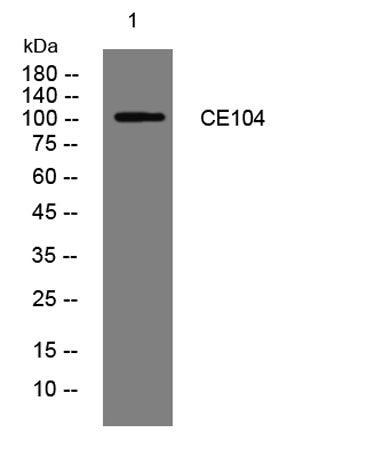
1
/
of
1
ELK Biotechnology
SKU:ES17531
CE104 rabbit pAb
CE104 rabbit pAb
Regular price
$250.00 USD
Regular price
Sale price
$250.00 USD
Unit price
/
per
Shipping calculated at checkout.
Couldn't load pickup availability
Applications: WB
Reactivity: Human; Mouse
Source: Rabbit
Dilution: WB 1:500-2000
Immunogen: Synthesized peptide derived from human CE104 AA range: 415-465
Storage_stability: -20°C/1 year
Clonality: Polyclonal
Isotype: IgG
Concentration: 1 mg/ml
Human_gene_id: 9731
Human_swiss_prot_no: O60308
Subcellular_location: Cell projection, cilium . Cytoplasm, cytoskeleton, microtubule organizing center, centrosome, centriole . Cytoplasm, cytoskeleton, microtubule organizing center, centrosome . Cytoplasm, cytoskeleton, spindle pole. In interphase non-ciliated cells, localizes to the distal ends of both the mother and daughter centrioles. In ciliated cells, present at the distal end of the daughter centriole, but not on the mother centriole, and at the tip of primary cilium. Localization at the ciliary tip is also observed in motile cilia. Throughout S phase, associated with both mother and daughter centrioles in each centrosome. During metaphase and telophase, present at both spindle poles. .
Background: This gene encodes a centrosomal protein required for ciliogenesis and for ciliary tip structural integrity. The mammalian protein contains three amino-terminal hydrophobic domains, two glycosylation sites, four cysteine-rich motifs, and two regions with homology to the glutamate receptor ionotropic, NMDA 1 protein. During ciliogenesis, the encoded protein translocates from the distal tips of the centrioles to the tip of the elongating cilium. Knockdown of the protein in human retinal pigment cells results in severe defects in ciliogenesis with structural deformities at the ciliary tips. Allelic variants of this gene are associated with the autosomal-recessive disorder Joubert syndrome, which is characterized by a distinctive mid-hindbrain and cerebellar malformation, oculomotor apraxia, irregular breathing, developmental delay, and ataxia. [provided by RefSeq, Feb 2016],
Reactivity: Human; Mouse
Source: Rabbit
Dilution: WB 1:500-2000
Immunogen: Synthesized peptide derived from human CE104 AA range: 415-465
Storage_stability: -20°C/1 year
Clonality: Polyclonal
Isotype: IgG
Concentration: 1 mg/ml
Human_gene_id: 9731
Human_swiss_prot_no: O60308
Subcellular_location: Cell projection, cilium . Cytoplasm, cytoskeleton, microtubule organizing center, centrosome, centriole . Cytoplasm, cytoskeleton, microtubule organizing center, centrosome . Cytoplasm, cytoskeleton, spindle pole. In interphase non-ciliated cells, localizes to the distal ends of both the mother and daughter centrioles. In ciliated cells, present at the distal end of the daughter centriole, but not on the mother centriole, and at the tip of primary cilium. Localization at the ciliary tip is also observed in motile cilia. Throughout S phase, associated with both mother and daughter centrioles in each centrosome. During metaphase and telophase, present at both spindle poles. .
Background: This gene encodes a centrosomal protein required for ciliogenesis and for ciliary tip structural integrity. The mammalian protein contains three amino-terminal hydrophobic domains, two glycosylation sites, four cysteine-rich motifs, and two regions with homology to the glutamate receptor ionotropic, NMDA 1 protein. During ciliogenesis, the encoded protein translocates from the distal tips of the centrioles to the tip of the elongating cilium. Knockdown of the protein in human retinal pigment cells results in severe defects in ciliogenesis with structural deformities at the ciliary tips. Allelic variants of this gene are associated with the autosomal-recessive disorder Joubert syndrome, which is characterized by a distinctive mid-hindbrain and cerebellar malformation, oculomotor apraxia, irregular breathing, developmental delay, and ataxia. [provided by RefSeq, Feb 2016],
Share